Volume 9, Issue 4 - April 2026
|
Shame, Healthcare, and Professionalism
By: Bryan Pilkington, PhD
|

Ever since reading Bernard Williams Shame and Necessity1 in graduate school, I’ve been fascinated with the concept of shame. It is one of the more interesting concepts both in discussions of ethics and historically, but its appreciation in medicine and in health professions education, more generally, has not always been robust. This issue of The Academy is devoted to thinking about the concept of shame in the health professions and in education.
There are a number of descriptions of the content, its rhetorical use, and its normative implications, and a year’s worth of issue of The Academy could be devoted to parsing out those descriptions; in this issue, we focus on more practical considerations. In our first article, “Professionalism and Shame,” noted scholars of the subject matter, Will Bynum and Luna Dolezal address shame as arising in the space between the actual and the ideal. They bring a plethora of experience and thought to this article, including years of work at their renowned Shame Lab (https://www.shamelab.org/) to helpfully frame the conversations you might have in response to the topics in this issue.
The second article in our April issue, “Addressing Shame in Health Professions Education Through Self-Compassion” by Gioconda Mojica highlights the importance of compassion in healthcare professionalism and especially in educational contexts. The oft-discussed role of learner feedback can, Mojica explains, not only be an instance of feedback but also one that brings with it learner experiences of shame. Mojica asks, and responds to, the powerful question, “But what if medical education also taught learners how to respond to these moments with compassion rather than self-criticism?”
In our final article, “First Do No Harm, Including to Yourself,” Angelo Cadiente and Jamie Chen discuss shame in medicine from the perspectives of current residents. Cadiente and Chen reflect on systems, hidden curricula, and the destructive emotion that shame – as they conceptualize it – can be and how we all might do better.
In addition to the usual goings on about the professionalism town – announcements, members achievements, etc – I want to highlight two very interesting upcoming events. The first is an APHC Roundtable with Otolaryngologist Kevin C. McMains. McMains wrote a provocative piece on the potential negative side of humility in medicine, which appeared in The Academy last year. On Friday at the early hour of 7am, he will discuss another paper, "The Hero's Journey: Situating Professional Identity Growth During Graduate Medical Education." Do attend. The second event that should be noted is the upcoming APHC conference in early June. See further information below, and be sure to register and attend to join conversations about the latest work in healthcare professionalism.
Readers will also notice a new section, Letters to the Editor. This is our first issue with such a section. Though we’ve received many over our couple year run, we now have the opportunity to publish them in this new section. If something in this or a previous issue strikes you or if you can lend some additional expertise to our conversations, please send us a letter. You can email us (exec@aphc-mail.org) – proper post takes some time – but please keep the notes under 250 words.
Enjoy the issue and thanks to our authors for such thought-provoking articles.
REFERENCES
- Williams, Bernard. Shame and Necessity, Second Edition. 2nd ed. Sather Classical Lectures, v. 57. University of California Press, 2008.
Bryan Pilkington, PhD, is Professor of Bioethics, in the Department of Medical Sciences, at Hackensack Meridian School of Medicine, and the Editor-in-Chief of The Academy: A Forum for Conversations about Health Care Professionalism.
|
|
|
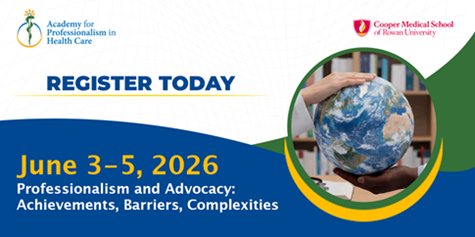
Join a vibrant, inclusive community of professionals dedicated to advancing professionalism in health-related fields at this year’s Hybrid International Conference, hosted in person at Cooper Medical School of Rowan University (Camden, NJ) and virtually via Zoom.
This dynamic event features:
- Keynote Presentations
- Symposia
- How-To Workshops
- Problem-Solving Sessions
- Expert Panels
- Oral Presentations
- Flash Presentations
All sessions are hybrid and will be recorded for on-demand access after the event.
With over 60 engaging sessions, you'll have plenty of opportunities to network and explore critical themes, including:
- Importance of Advocacy for Healthcare Professionals – Generational and Cultural Differences
- Advocacy Training Programs and Effective Teaching Methods
- When to Advocate for Patients, Learners, Co-workers?
- Self-Advocacy – A Key to Wellness and Success for Patients, Learners and Professionals
- Intra- and Inter-professional Advocacy in Teams (e.g., Priorities Negotiations)
- Who Needs Help - Patients, Providers, Systems?
- International Perspectives on the Role of Advocacy in Healthcare
- Advocacy and Professionalism: Balancing Opportunities and Boundaries
- Advocating for Justice and Peace – An Ethical Responsibility of Healthcare Professionals?
🎓 Whether you're attending in person or online, this is your chance to be part of a global conversation shaping the future of professionalism in health care.
👉 Click here to for more info
👉 Click here to register
👉 Click here for nearby hotels
Back to Table of Contents
|
|
|
Professionalism and Shame
By: Will Bynum, Duke Univeristy and Luna Dolezal, University of Exeter
|
At the heart of professionalism in healthcare lies a set of standards, ideals, and norms that guide how we are expected to act, when serving patients, systems and society, but that also shape who we are expected to be and become. Accordingly, they establish the contours of the ideal self and deeply influence how we come to feel about ourselves. In this way, professional standards are not just directive; they are aspirational.
It is in the space between the actual and the ideal that shame can emerge. Shame is a painful, self-conscious emotion that arises when we perceive ourselves as falling short of a standard, ideal, or norm, or when we feel judged by others for falling short. Shame brings with it painful feelings of exposure and negative judgment, and it can prompt behaviors ranging from withdrawal and disengagement, to overcompensation and unhealthy perfectionism, to defensiveness and blame. While shame is a normal human emotion—one that we have evolved to facilitate group cohesion, social functioning, and belonging—it can be highly distressing and is associated with a wide range of negative outcomes among learners and clinicians in healthcare.
Opportunities to experience shame in healthcare are everywhere. Amidst striving for extraordinarily high standards of performance, captured in the enduring pledge to “first do no harm”, the possibility of falling short exists at every turn: in the struggles of learning,1 in medical error,2 in lapses in empathy, and in perceived or actual violations of professional standards.3 While many such shame triggers are inevitable (e.g., learning, struggle, and errors), others are not, or should not be.
Indeed, the structures through which professionalism is shaped and enforced—including pedagogies, systems of evaluation, and the hidden curriculum—continuously position learners and clinicians in relation to, and in comparison with, prevailing ideals of practice and identity. Professionalism, in this sense, does not just guide behavior. It creates conditions under which the self can be experienced as inadequate, easily resulting in experiences of shame.
Importantly, this experience is not evenly distributed.
Professional ideals are not constructed in a vacuum. They are shaped by history, culture, and power. The implicit prototype of the “ideal clinician” has long reflected dominant norms—often white, male, socially privileged, able-bodied, emotionally restrained, and culturally aligned with existing hierarchies.4 For those who see themselves reflected in that image, professionalism may feel aspirational and attainable. The gap between self and ideal, while uncomfortable at times, may feel bridgeable.
For others, whose identities, ways of communicating, or ways of being are less represented, the experience can be quite different. The standards may feel distant or conditional, may require editing parts of oneself to fit, and may signal, subtly or overtly, that belonging is contingent. Experiences such as assimilation pressure and code-switching, which are reported frequently by minoritized and/or underrepresented students, reflect these shame-adjacent pressures.5
In these contexts, shame can become less episodic and more chronic.6 It is no longer tied only to what one has done, but to who one is perceived to be.
Shame-propagating professional standards show up in everyday ways: how “professional tone” is interpreted differently depending on who is speaking; how norms around appearance or emotional expression are enforced; and how feedback can drift from behavior into identity. These dynamics are rarely intentional or explicitly acknowledged, yet they remain emotionally consequential: amid the already high expectations in medicine, the added pressure to align with uneven professional norms can erode aspects of identity and self-esteem, contributing to burnout, stress, and dissatisfaction.
None of this is an argument against professionalism. Standards are necessary, and patients deserve clinicians who are accountable, skilled, and trustworthy. The question is not whether we should have professional standards; rather, we should ask: how those standards are constructed, enacted, and experienced?
Examining professionalism through a lens of shame competence can help us answer this question. Shame competence is a set of skills, principles, and practices that we all can learn and that facilitate constructive engagement with shame in professional practice.7 Shame competence is a lens through which we can understand how standards influence what people think and feel about themselves within professional settings. Importantly, shame competence asks us to examine whether professional standards are unfairly or unjustly positioning some people to feel that they are forever falling short of an ideal.
Shame competent professionalism might begin with making our standards more explicit—not only what they are, but where they come from and whom they are designed to serve. It would involve interrogating the implicit ideals embedded within them and asking whose identities are centered and whose are marginalized.
Shame competence would also mean attending to how we respond when standards are not met. Do we move quickly to judgment, shaming and blaming? Or do we create space for reflection, context, and repair? Do we treat professionalism lapses as evidence of a flawed self, or as part of a developmental process? Can we openly acknowledge that some of our professional standards may be flawed, biased, or rooted in outdated norms? And if so, do we have the collective resolve to begin the work of evolving them?
Perhaps most importantly, shame competence would involve naming and normalizing the role of negative self-conscious emotions, like shame. It would entail recognizing when they are affecting us an those around us in ways that shape our behavior, our relationships, and the environments we create for learning and care.
If professionalism in healthcare is to truly serve both clinicians and patients, it must move from a standard that quietly judges to one that actively supports the full humanity of those who practice within it.
REFERENCES
- William Bynum, Pim Teunissen, and Lara Varpio, "In the “Shadow of Shame”: A Phenomenological Exploration of the Nature of Shame Experiences in Medical Students," Academic Medicine 96, no. 11S (2021).
- Will Bynum, Luna Dolezal, and Steven Thornton, "Shame Competent Response to Medical Error," American Family Physician 112, no. 3 (2025).
- Sandy Miles, "Addressing shame: what role does shame play in the formation of a modern medical professional identity? ," BJPsych Bulletin 44, no. 1 (2020).
- Brenda L. Beagan, "Neutralizing differences: producing neutral doctors for (almost) neutral patients," Social Science and Medicine 51 (2000).
- Anita K. Blanchard, "Code Switch," New England Journal of Medicine 384, no. 23 (2021).
- Luna Dolezal, "The Horizons of Chronic Shame," Human Studies 45 (2022).
- Luna Dolezal and William Bynum, "Shame Competence: Addressing the Effects of Shame in Healthcare," The Lancet 404, no. 10462 (2024).
WORKS CITED
- Beagan, Brenda L. "Neutralizing DiFferences: Producing Neutral Doctors for (Almost) Neutral Patients." Social Science and Medicine 51 (2000): 1253-65.
- Blanchard, Anita K. "Code Switch." New England Journal of Medicine 384, no. 23 (2021): e87.
- Bynum, Will , Luna Dolezal, and Steven Thornton. "Shame Competent Response to Medical Error." American Family Physician 112, no. 3 (2025): 330-33.
- Bynum, William, Pim Teunissen, and Lara Varpio. "In the “Shadow of Shame”: A Phenomenological Exploration of the Nature of Shame Experiences in Medical Students." Academic Medicine 96, no. 11S (2021): S23-S30.
- Dolezal, Luna. "The Horizons of Chronic Shame." Human Studies 45 (2022): 739-59.
- Dolezal, Luna, and William Bynum. "Shame Competence: Addressing the Effects of Shame in Healthcare." The Lancet 404, no. 10462 (2024): 1514-15.
- Miles, Sandy. "Addressing Shame: What Role Does Shame Play in the Formation of a Modern Medical Professional Identity?." BJPsych Bulletin 44, no. 1 (2020): 1-5.
Will Bynum and Luna Dolezal are co-Directors of The Shame Lab, a research organization looking at shame in professional practice, providing training and consultancy in shame competence. https://www.shamelab.org/.
Back to Table of Contents
|
Addressing Shame in Health Professions Education Through Self-Compassion
By: Gioconda Mojica, MD
|
Imagine a medical student leaving rounds replaying a moment in their mind, the words echoing long after rounds. After the presentation, the attending asks a question. The student hesitates, searching for the answer, and hears the words: “You should know this by now.” The comment may have been brief, yet the internal message lingers much longer. For many learners, moments like this are not simply feedback. They can become experiences of shame that shape how learners see themselves, their abilities, and their place in medicine.
But what if medical education also taught learners how to respond to these moments with compassion rather than self-criticism?
Shame is an emotional experience that often remains hidden in health professions education, yet it shapes how learners see themselves, their abilities, and their place in medicine. Experiences such as public criticism, mistakes in clinical settings, or comparisons with peers can trigger feelings of inadequacy and isolation. National survey data suggest that a substantial proportion of medical students report experiences of embarrassment or humiliation during training, highlighting the importance of addressing the emotional climate in which learning occurs.
While medicine equips trainees with knowledge and technical skills to care for others, learners are rarely taught how to respond to their own difficult emotions. In particular, shame can threaten professional identity formation and contribute to burnout, withdrawal, and reduced empathy. These realities prompted our team to explore whether educational interventions could help learners recognize and navigate shame more constructively.
Our recently published study1 describes the development and evaluation of a voluntary elective titled Fostering Connection and Shame Resilience Through Self-Compassion. The elective was designed to introduce health professions learners to the concept of self-compassion and to provide practical strategies for responding to challenging emotional experiences that arise during training.
Self-compassion, as conceptualized by psychologist Kristin Neff, includes three key components: mindfulness, recognition of common humanity, and self-kindness. Rather than responding to personal setbacks with harsh self-criticism, self-compassion encourages individuals to acknowledge difficulty with understanding and a more balanced perspective. Research shows that self-compassion is associated with greater emotional resilience and lower levels of shame.
The elective consisted of three two-hour sessions offered monthly over a three month period. Each session incorporated several elements that are not commonly emphasized in traditional medical education: connection building, reflective writing, experiential exercises, and small group dialogue. Participants began each session with a shared meal intended to foster community and psychological safety before discussing emotionally sensitive topics.
Large group discussions introduced frameworks for understanding shame and self-compassion in the context of health professions training. Learners then engaged in reflective writing and guided self-compassion practices, including simple exercises that could be used during stressful moments in clinical work. Finally, faculty facilitated small group conversations where participants could explore how these themes related to their own experiences.
Evaluation of the elective suggested meaningful shifts in learners’ self-compassion. Participants demonstrated statistically significant improvement in multiple elements of the Self-Compassion Scale, including self-kindness, reduced self-judgment, mindfulness, and recognition of common humanity. Overall self-compassion scores increased from the low range to the moderate range by the end of the course.
Although total scores on the Shame Frequency Questionnaire did not significantly differ from controls, item level analyses revealed meaningful changes in several areas related to professional identity, including feelings of belonging in healthcare and perceptions of competence. These findings suggest that even brief educational interventions may influence how learners interpret and respond to difficult experiences during training.
Beyond the quantitative outcomes, the structure of the elective offers lessons for educators interested in supporting learner well-being and professionalism. Creating opportunities for connection, reflection, and open dialogue allowed students to recognize that many of their struggles were shared by peers. Faculty vulnerability in discussing their own experiences with shame also helped normalize these conversations and foster psychological safety.
Our experience suggests that teaching self-compassion may provide learners with a practical internal resource during difficult moments in their professional journey. By helping trainees respond to challenges with curiosity rather than self-criticism, such approaches may support both personal well-being and the development of compassionate physicians.
Learning to practice self-compassion in clinical and learning environments may also have implications beyond the individual learner. When clinicians cultivate kindness toward themselves in moments of difficulty, it can strengthen their capacity to extend compassion to patients and colleagues. In this way, compassion for oneself may serve as a foundation for compassion toward others.
Equally important is what learners observe from their teachers. When attendings acknowledge uncertainty, respond to mistakes with humility, or demonstrate kindness toward themselves in difficult moments, they model an important professional norm: that physicians are human, not machines. These moments can help create psychological safety within learning environments. When learners feel safe to ask questions, admit uncertainty, or share ideas without fear of humiliation, the conditions for deeper learning and collaboration emerge.
In this way, self-compassion is not only an individual coping strategy but also a cultural signal. Modeling it openly may help shape learning environments that are more humane, more collaborative, and ultimately more supportive of both professional growth and patient care.
Imagine how the future of medicine might change if learners were taught to extend the same compassion inward that they so readily offer their patients.
REFERENCES
- Mojica, Gioconda et al. “Fostering Connection and Shame Resilience Through Self-Compassion: An Innovative Elective for Health Professions Learners.” Journal of medical education and curricular development vol. 13 23821205261420679. 11 Feb. 2026, doi:10.1177/23821205261420679.
ADDITIONAL RESOURCES
Dr Gio. Mojica is Assistant Professor of Ophthalmology at McGovern Medical school, and Lyndon B. Johnson Hospital, a safety net hospital within the Harris Health System.
Back to Table of Contents
|
First Do No Harm, Including to Yourself
By: Angelo Cadiente, MD, MPH, and Jamie Chen, MD
|
Among the experiences that define the transition from medical student to first year resident, i.e. an “intern”, shame harbors an under-examined but formidable place. Unlike guilt, which centers on a discrete act – "I made an error" – shame implicates the self in its totality: "I am an error." This distinction, first articulated by Helen Lewis in 1971 and later expanded by Tangney and Dearing in 2002, carries experientially apparent implications for the clinical environment, where the stakes of performance are inseparable from patient welfare. For the intern parsing out the hierarchy of graduate medical education, shame is a near-constant companion, shaped by institutional culture, corrective teaching, and the weight of new responsibility.
Intern year is, by design, a test of a new doctor’s ability. Interns are expected to function clinically before they are clinically competent, a paradox that often produces the conditions for shame. When a new intern is “pimped” on rounds, e.g. asked in rapid succession about drug dosages, pathophysiology or management algorithms, and cannot answer, the experience is rarely one of neutrality, but of exposure. There is an audience: senior residents, attending physicians, nurses, and sometimes patients themselves. The intern's knowledge gap, however developmentally appropriate, is rendered public and internalized as evidence of personal inadequacy. This is the phenomenology of shame: the shrinking, the wish to disappear, the conviction that one does not belong.
The hidden curriculum of medicine reinforces these dynamics. Hafferty's (1998) foundational work on the hidden curriculum describes the implicit norms, values, and behavioral expectations instilled in medical training outside of formal instruction. Within this curriculum, uncertainty is perceived as incompetence. Interns learn quickly that the admission of not knowing is a social cost. They adapt by performing confidence they do not feel, suppressing questions that might signal ignorance, and internalizing the belief that struggle is an internal pathology rather than a developmental norm. The result is a pervasive culture that transforms shame from a transient emotional response into a chronic psychological struggle.
It would be misleading, however, to characterize shame as entirely maladaptive. Working through feelings of inadequacy to build upon one’s self-worth perpetuates growth. It is the ability to tolerate this self-doubt, i.e. the recognizing that one's actions have implications for others while bearing the moral weight as a physician, that can drive the pursuit of clinical excellence. The intern who feels nothing after a preventable error is detached from their training. The question is not whether shame belongs in medicine, but instead assessing if the current training environment cultivates it in forms that serve learning and professional formation, or in forms that corrode them. As Nussbaum (2004) argues in her philosophical treatment of shame, the emotion becomes destructive when it is directed at immutable characteristics or at developmental stages that are, by definition, temporary.
The intern's incompetence is temporary; yet, their shame need not be. What residency programs can offer is an environment in which the shame of not knowing yields to the more adaptive experience of learning to know. This requires attending physicians who can name their own uncertainty aloud, senior residents who can share their early errors without minimizing them, and institutional structures that can provide the environment to seek growth in the face of difficulty. It requires, ultimately, a culture willing to acknowledge that the formation of a physician is not the suppression of a human being, but its careful continuation.
The intern standing at 3 a.m. outside a patient's room, uncertain of their next step, uncertain of themselves, is not yet the physician they will become. They are, in that moment, exactly what the system made them: inexperienced, exhausted, and acutely aware of how much they do not know. Whether that awareness becomes the foundation for a career of intellectual humility, or calcifies into shame that impedes growth, depends in no small part on what happens next – and who is watching.
REFERENCES
-
Hafferty, F. W. (1998). Beyond curriculum reform: Confronting medicine's hidden curriculum. Academic Medicine, 73(4), 403–407.
-
Lewis, H. B. (1971). Shame and guilt in neurosis. International Universities Press.
-
Nussbaum, M. C. (2004). Hiding from humanity: Disgust, shame, and the law. Princeton University Press.
-
Tangney, J. P., & Dearing, R. L. (2002). Shame and guilt. Guilford Press.
Angelo Cadiente, MD, MPH is a Research Consultant at the Health Ethics Lab at Hackensack Meridian School of Medicine. Dr. Cadiente is currently completing his OB/GYN Residency at Maimonides Medical Center in Brooklyn, NY, where his research focuses on the ethical use of AI in medicine, geospatial analyses for access to care, and protections for vulnerable populations.
Jamie Chen, MD is currently completing her Ophthalmology Residency at UMass Chan in Worcester, MA and serves as a Research Consultant at the Health Ethics Lab at Hackensack Meridian School of Medicine. Her bioethics interests center on AI in medicine, justice and vulnerability in research populations, and the ethical implications of medical innovation.
Back to Table of Contents
|
| |
 Letter to the Editor Letter to the Editor
By: Tom Koch
|
It is good to have read in recent bulletins the submissions of medical students contemplating both the Hippocratic tradition and the nature of ‘professionalism,” the latter by Amanda Brand, the former by Guy Stein. The two subjects are entwined, historically, and the ideas deserve attention.
It is important to remember the Hippocratic Oath was one page in a corpus of over 600 works covering every aspect of the practice of medicine and then existing knowledge of medicine, health and healthy communities. It sits in a series of books on not only Epidemics but also, in Air Water and Places on the need for good water, good air, and good housing…
The Hippocratic professional served, historically, as advisor and activist. Literatures from the early Mercantile period through 19th century industrialization set the physician in caring relation with the patient but also with society at large. In a real way they become Jane Jacob’s guardians, citizens who on the basis of their knowledge argued for better living conditions and healthy necessities in the face of commercial or political perspectives.
Alas, too often the broad reach and complexity of the Hippocratic Compact is forgotten, especially its insistence on the practitioner as interpersonal carer and social critic in the face of commercial excesses and political failures.
Tom Koch is a medical ethicist, geographer and historian at the University of British Columbia. His most recent books are Seeking Medicine’s Moral Centre: Ethics, Bioethics, and Assistance in Dying and Ethics in Everyday Places: Mapping Moral Stress, Distress, and Injury.
Back to Table of Contents
|
|
|
|
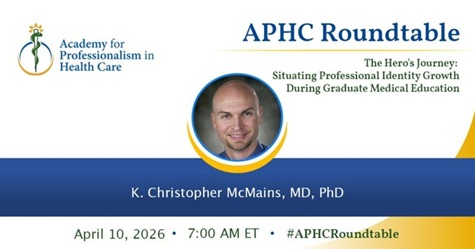
The Roundtable will be held at 7:00 a.m. ET as a pilot, based on feedback from the recent APHC Roundtable Survey. The Roundtable scheduled for Friday, May 8 will take place at 3:00 p.m. ET, and future meeting times will be evaluated based on participation and feedback.
Otolaryngologist Kevin C. McMains discusses his article “The Hero’s Journey: Understanding Professional Identity Formation in Graduate Medical Education,” exploring burnout and mental health challenges in medical training. During this interactive roundtable, he critiques traditional frameworks that position work and life as opposing forces and introduces the hero’s journey as an alternative narrative—one that helps trainees find meaning in sacrifice, deepen connections with patients, and cultivate resilience and compassion. The session will also invite participants to reflect on key big‑picture questions facing health care professionals today.
About the Presenter:
Dr. Kevin “Chris” McMains, MD, PhD is an ENT Surgeon who specializes in endoscopic sinus surgery. He completed medical school at UT-Southwestern at Dallas, Surgical Internship, Otolaryngology Residency, and Rhinology Fellowship at the Medical College of Georgia. From 2005-2009, he was on full-time faculty with the ENT residency at UTHSC-San Antonio, serving as Associate Program Director and Program Director. After 2 years in private practice, he began as Chief of ENT at the South Texas Veterans Health Care System. Currently, he serves as the Director of Faculty Development at the Audie L Murphy Division. He hold the academic rank of Professor in the Departments of Surgery and Health Professions Education at Uniformed Services University of Health Sciences as well as Adjoint Professor in the Departments of Otolaryngology/Head and Neck Surgery and Medical Education at University of Texas San Antonio.
🔎 Explore Dr. McMains’ work ahead of the session:
https://tinyurl.com/bd4we3zd
https://tinyurl.com/4a4fhaym
Register at: https://tinyurl.com/2026Roundtables
Roundtables are for APHC Members only.
Check out our membership benefits here.
Join APHC to access previous Roundtable recordings.
Back to Table of Contents
|
Healthcare Professionalism: Education, Research & Resources Podcast
|
Professional Formation and APHC collaborate on a podcast, Healthcare Professionalism: Education, Research & Resources.
Over 125 podcast episodes have been released with over 17,000 downloads.
Released every other Saturday morning, recent episodes include Rachel Pittmann discussing Telehealth Etiquette and Amal Khidir talking about Designing the Faculty Development Professionalism Program with Multi-cultural Perspectives.
You can access the podcast episodes on your favorite platform or at: https://bit.ly/PF-APHC-Podcast
Back to Table of Contents
|
APHC Member Announcements
|
If you are an APHC member, we will publicize your events, job searches, research, grants, articles, podcasts, books, etc., in the newsletter.
Application Process for 2026-2027 ABMS Scholars Cohort is Now Open
The application process for the 2026-2027 ABMS Scholars cohort is now open. This one-year, part-time program supports the research of early-career physicians and research professionals, while facilitating leadership development through engagement with ABMS and the broader certification community. Applications must be received by 11:59 pm CT on June 22, 2026, and additional information about the application process is available on the ABMS website. Interested candidates may also register to attend a free, hour-long informational webinar to learn more about the ABMS Scholars Program. The webinar will be held at 5:00 pm CT on April 28 and will be recorded and shared with all registered attendees.
Accepting Applications
The McGovern Center for Humanities and Ethics is now accepting a second cohort for its workforce training program in medical humanities! Designed for physicians, the program can be used for self-development; reconnection and renewal; and creating medical humanities materials for your own teaching.
For more information: https://go.uth.edu/medical-humanities-workforce-program
Back to Table of Contents
|
As a member, you have access to special benefits that include:
- Belonging to a community of like-minded professionals
- Participating in the monthly Professionalism Education
Roundtables with authors, faculty, and researchers, plus accessing past recordings
- Accessing 15 Professional Formation modules for individuals for free
- Enrolling in the APHC Faculty Development Certificate program known as LEEP (Leadership Excellence in Educating for Professionalism), which was launched in 2020 and offers longitudinal mentoring for a select group of
individuals seeking to deepen their knowledge and skills in
professionalism education, assessment, and research
- Posting your research, articles, podcasts, webinars, conferences, and books in the newsletter distributed to about 15,000 people
- Receiving a 20% discount on educational videos created by the Medical Professionalism Project, which also allows you to obtain MOC and CME
- Registering for APHC conferences with discounts
- Participating in APHC committees, which include the conference program, membership, and education committees
Our annual membership fees are very inexpensive and are valid for one year from the payment date. Select from seven types of membership, including the institutional membership for four people. See the descriptions.
Back to Table of Contents
|
The Academy Newsletter Editors
|
Editor-in-Chief: Bryan Pilkington | Managing Editor: Yvonne Kriss
Please contact Yvonne if you'd like to contribute an article to this newsletter.
If you know someone who would benefit from reading Professional Formation Update, please pass this along. They can subscribe to the newsletter by clicking here.
|
Academy for Professionalism in Health Care
PO Box 20031 | Scranton, PA 18502
|
Follow us on social media.
|
|