Volume 9, Issue 2 - February 2026
|
Acting with Professionalism: Responding to Vulnerability
By: Bryan Pilkington, PhD
|

The February issue of The Academy for 2026 takes up questions rooted in the consideration of vulnerability, harm, and psychiatry. Two thought-provoking articles and a book review comprise the issue, which also includes the customary professionalism event information and member announcements.
In our lead article, “Involuntary Commitment & The Physician’s Responsibility to Do No Harm,” Gabriel Salazar considers the role that “do no harm” has on health professionalism in the practice of psychiatry. Salazar is especially interested in situations which might call for involuntary holds, and traces a potential profession-based requirement of nonmaleficence through to the Hippocratic corpus, to make his case. Most discussions of professionalism highlight the importance of the positive side of the ethics principle of beneficence, which is ought couched in accounts of professionalism as the requirement of altruism. Salazar picks up on the negative side of that coin, the ethical principle of nonmaleficence, making a strong case for psychiatrists to consider it in their self-reflections on professionalism and their professional practice.
In our second article, Stephen Kanter argues that if health professionals are to practice with professionalism, then they must aim to foresee and address obstacles facing potential patients. Similar, in some ways, to the ethical “duty to plan” principle – which gained increased notoriety during and after the COVID-19 pandemic – Kanter argues that professionalism requires consideration of the vulnerabilities of patience in all aspects of the patient encounter. In particular, Kanter is interested in creating fitting spaces for patients with physical disabilities, highlighting that even simple decisions to change restroom layouts or what might appear to be mundane changes to soap dispensers have real world impacts. Forward looking health professionals ought to ensure that patients can access care that they need and Kanter makes a persuasive case for a professionalism-based, vulnerability-attentive practice in health care.
Our final article, “On the Whistleblower and Narcissism: A Review of The Occasional Human Sacrifice,” is a review of the recent book in research ethics and the history of medicine by Carl Elliott. Elliott’s The Occasional Human Sacrifice: Medical Experimentation and the Price of Saying No has been lauded in many circles, and for good reason. This well-written, well-argued, if somewhat depressing, work highlights the challenge of whistleblowing in healthcare spaces (a topic that Jill Thistlethwaite took up in our April issue of last year). Noto offers a new read on Elliott’s work, critically assessing it and raising questions, germane to the field of psychiatry, about personality types and whistleblowing.
The issue concludes with the usual cluster of information about upcoming professionalism events – be sure to plan to attend the June conference and the upcoming roundtables – as well as important member announcements.
Until March…
Bryan Pilkington, PhD, is Professor of Bioethics, in the Department of Medical Sciences, at Hackensack Meridian School of Medicine, and the Editor-in-Chief of The Academy: A Forum for Conversations about Health Care Professionalism.
|
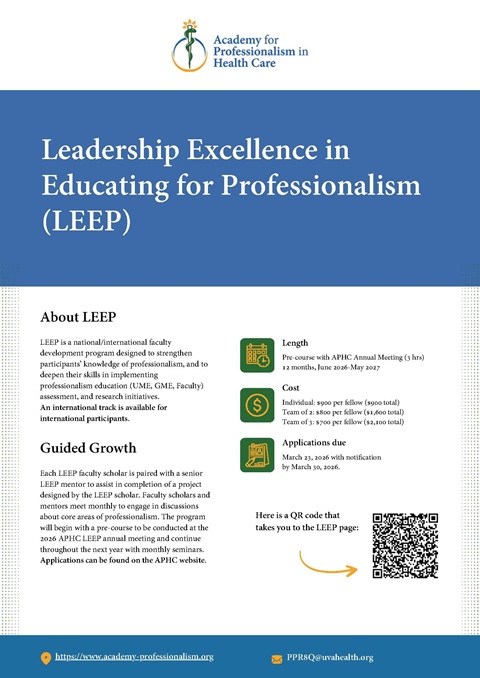
Now Accepting 2026-2027 LEEP Applications
|
Involuntary Commitment & The Physician’s Responsibility to Do No Harm
By: Gabriel Salazar
|
To be a medical physician is to take into one’s hands the health and lives of people in need. You will see them at their most vulnerable, their weakest, and their most fearful. It’s only right that a certain code of conduct be taken when seeing to their treatment and recovery. For centuries, the Hippocratic Oath and its overarching dictum of “Do no harm,” has been the foremost guiding principle of this ethical code. Within the field of psychiatry, the act of doing no harm can become complicated when it comes to properly treating the mentally ill.
In T.A. Cavanaugh’s book, Hippocrates’ Oath and Asclepius’ Snake: The Birth of the Medical Profession, the erudite author describes three perspectives when it comes to causing harm – the Hippocratic, which opposes all intentional injury, the Asclepian, which views certain intentional injuries as beneficial, and the Apollonian, which views certain intentional injuries as a less harmful alternative to a more harmful outcome. These can be useful perspectives to take when examining current treatment protocols in psychiatry, particularly the contentious act of involuntary psychiatric admissions (IPA). With an involuntary hold, a patient can be admitted to an in-patient psychiatric unit against their will if they are deemed to be a potential danger to themselves or others, and are not of sound mind to make their own decisions. The perspective taken by the psychiatrist when making these decisions is often the Asclepian one – the unwell patient is being held and treated against their will for their own benefit and the benefit of others, despite the breach of personal autonomy.
In the ideal situation, receiving proper medication does allow the patient to return to a normal state of mind and the true benefit of the involuntary hold is manifested. However, this is not always the case, and further long term harms can also be a potential consequence. Some research has suggested that IPA’s may have little to no long term benefit on mental health, and may actually cause symptoms of PTSD or worsening suicidality (Iudici et al., 2022). The more pragmatic perspective to take here may be the Apollonian. We recognize that there is some harm in admitting someone involuntarily, but we maintain that the harm we cause is relatively less than the alternative of letting someone continue in their psychosis or other mental health episode.
In situations such as this, it may be impossible to make a decision that eschews any and all harm altogether. To involuntarily admit someone necessarily strips them of their autonomy and may cause further mental/emotional harm, but to let them languish in a mental health episode untreated may also lead to harm. With this in mind, is it even possible to view IPA as neither Asclepian nor Apollonian but actually a practice of Hippocratic medicine? Cavanaugh highlights that the practice of medicine does not necessarily exclude wounding, and that even proper curative medical treatments can carry with them harmful side effects, such as with chemotherapy. He emphasizes that these sorts of wounds may never be eliminated from medicine, and remain “part and parcel of good, even excellent medical practice.” (p. 20). Can the potential harms associated with IPA then be viewed as unfortunate side effects of a medical treatment conducted with healing intent? Side effect type wounds are often considered when providing treatments for physical conditions with physiological side effects, but in this instance we have treatments for mental conditions with potentially mental, emotional, and physical side effects. That is because aside from previously mentioned harms of trauma or worsening depression, IPA can sometimes involve usage of physical restraints, and heavy antipsychotic usage, which can carry with it certain physical side effects. At what point are the side effects considered not worth the treatment?
To choose not to involuntarily admit a patient in bad enough of a state to be eligible for involuntary admission is to allow them to remain a risk to both themselves and others. Despite evidence of harms caused by IPA, it also has evidence demonstrating that it can be beneficial in the short and long term. In ideal conditions, the psychiatrist would balance only the risk of letting someone walk untreated versus the risk of harm from IPA. However, in this litigious country, there is also a liability risk of letting someone experiencing a severe mental health crisis refuse treatment and walk freely. Therefore, a patient refusing IPA presents a potential risk to themselves, to others, and to the hospital and physician who let them walk. Consequently, the threshold for IPA may be lower than it otherwise would be without the risk of litigation. Thus we find that the commitment to “do no harm,” the aim to benefit or choose the option which leads to less harm, is further complicated by the threat of legal ramifications.
In both Ancient Greece and modern society, a code of ethics is vitally necessary to guide a physician’s conduct. Yet even a pithy aphorism like “do no harm,” becomes difficult to fully adhere to when harm seems inevitable and difficult to compare. In an ideal world, the threshold for involuntary hospitalization would be high, the greatest of care taken to ensure the comfort and autonomy of the individual are respected, and that a strong therapeutic alliance could be established afterwards so that any future hospitalizations would not be involuntary. There would also be less concern for litigation and liability when a provider erred on the side of respecting autonomy. As we do not live in that ideal world, the psychiatrist must do what they believe is best for the particular case that is presented to them, taking into account the many factors at play. Primum non nocere should always be the goal, but we must acknowledge it may not be the outcome.
REFERENCES
Corderoy, Amy, et al. "The benefits and harms of inpatient involuntary psychiatric treatment: A scoping review." Psychiatry, Psychology and Law (2024): 1-48.
Iudici, Antonio, et al. "Implications of involuntary psychiatric admission: health, social, and clinical effects on patients." The Journal of Nervous and Mental Disease 210.4 (2022): 290-311.
Parsa-Parsi RW. The Revised Declaration of Geneva: A Modern-Day Physician’s Pledge. JAMA. 2017;318(20):1971–1972. doi:10.1001/jama.2017.16230
Gabriel Salazar is a 4th year medical student at Hackensack Meridian School of Medicine.
Back to Table of Contents
|
Beyond the Exam Room
By: Prof. Stephen Kanter, Seton Hall University
|
Though the duty of healthcare professionals can be defined in different ways, the words within a profession’s practice act or job description are a good guide. Additional profession-specific duties are often listed within codes of ethics, and patient-centric guiding documents, such as the Patient’s Bill of Rights, should guide any number of healthcare providers. However, the usual guides fail to aid us in understanding what a healthcare professional’s duty is toward patients who are in need of assistance to physically access outpatient clinical facilities. Such access needs are not uncommon, and healthcare providers who aim to act with professionalism ought to consider how patients – all patients – might access necessary care modalities.
Though there are a variety of potential access challenges, I focus on physical barriers, given my professional practice of physical therapy. Physical barriers include, but are not limited to: stairs, narrow doorways, and insufficient floor space and grab bars in public restrooms. These barriers can restrict patients from scheduling or attending appointments with healthcare providers. People affected by physical barriers include those with acute or chronic mobility limitations, including wheelchair users. And it should be remembered that access challenges not only affect the patient, but these barriers may keep a family member or caregiver, who is supporting the patient during their healthcare experiences, from accessing and, in turn, limit the patient’s opportunities.
The Americans with Disabilities Act (ADA) was passed in 1990. However, the guidelines from this legislation have not eliminated the discrimination it was intended to address. People who wish to access all spaces within outpatient healthcare offices may find their access to be limited, unsafe, or - in the worst cases - not even possible. For example, exam rooms are often not designed for wheelchair users to enter or transfer to clinical tables (Frost et al., 2015). Additionally, restrooms may not have space for someone using a walker or for a second person to assist a patient with personal hygiene activities (Mullick et al., 2011).
Is there any function more universal than the one’s need to use a restroom and practice good personal hygiene? The standards of infection control include access to handwashing spaces to be used after toileting. Current practice patterns unfortunately include replacing handwashing resources with anti-bacterial gels. Though this may seem like an innocuous change to some, it undermines the rights of patients who are now unable to wash their hands due to different placements of gel dispensers, which can be especially challenging for those with walking and balance function concerns. These practice adjustments create a second-class of patients, a group who, due to the structures placed in their paths, don’t fit – figuratively and literally.
The concept of the healthcare triangle, which considers access, quality, and cost of care when developing policies for healthcare systems, might prove a useful guide for responses to physical access considerations; however, because financial stakeholders use these three components to generate business models for healthcare entities, the primary stakeholder – the patient – may be the last to be properly considered. Operational stakeholders in a moderate to small outpatient healthcare office, such as licensed clinicians, clinical support staff, and administrators all can recognize the importance of physical accessibility, but such thought often occurs at the time a patient encounters the barrier.
In order for health professionals associated with outpatient services to act with professionalism, proactive processes to ensure physical accessibility must be put in place. Such processes ought to include regular reflection on physical accessibility. This might involve: consulting with accessibility specialists during the build-out of a medical office, analyzing accessibility post-occupancy, or reviewing episodes where patients were restricted in accessing spaces in the office. This work can result in healthcare professionals satisfying their legal and ethical duties, duties which are expected upon licensure, as well as enabling them to embody the professionalism that is demanded by their particular health profession. To return to the idea of the healthcare triangle, developing team review protocols and procedures, so all patients can receive equal levels of care and services, is both good healthcare and good business.
No matter how skilled a clinician is, nor how “nice” their office may look, when access is limited or eliminated by poor design, everything else is moot: the patient is penalized by not receiving any of those benefits because they literally cannot get in the door. This penalty may be neither desired nor intended by clinicians, who spent years developing themselves to serve patients – a key tenet, at least on most accounts, of professionalism – but focusing on what a clinician can do in an exam room is irrelevant if a patient cannot enter the office to begin with.
REFERENCES
Frost, K. L., Bertocci, G., Stillman, M. D., Smalley, C., & Williams, S. (2015). Accessibility of outpatient healthcare providers for wheelchair users: Pilot study. Journal of Rehabilitation Research & Development, 52(6).
Mullick, A., Preiser, W., & Ostroff, E. (2011). Universal bathrooms. Universal design handbook (p. 30.2). New York: McGraw-Hill.
Stephen Kanter, PT, DPT, ATC is a licensed physical therapist and accessible design consultant in Northern NJ and a professor of ethics and professionalism at Seton Hall University.
Back to Table of Contents
|
| |
On the Whistleblower and Narcissism: A Review of The Occasional Human Sacrifice
By: Jack Noto
|
In The Occasional Human Sacrifice, Carl Elliott thoughtfully shares his and others’ experiences as whistleblowers. His book is framed within the ethic of honor and shame. Elliott argues that the motivation of whistleblowers is driven not by narcissistic morality but by a duty to oneself and one’s conscience. This is in contrast to C. Fred Alford’s account of “narcissism moralized”. Pathologic narcissism, primarily characterized by the clinical diagnosis of narcissistic personality disorder (NPD), is characterized by a lack of empathy, grandiosity, and the exploitation of others. In Alford’s view, whistleblowers’ rigid adherence to their morality is a form of narcissism. They express a narcissistic desire to uphold their moral self and seek external validation (i.e. from their organization) which motivates them to blow the whistle. Alford goes on to explain the pitfalls of the whistleblower’s understanding of their organization and why whistleblowing ultimately fails. It’s his account of narcissism that interests me.
Many whistleblowers speak about personal identity, of upholding their values, of honor and shame. My issue with Elliott’s account is that it falls short of satisfyingly explaining whistleblowers’ motivations. Take the whistleblowers in the Watergate scandal. Butterfield is honest but only when directly asked; why does he hold this moral belief? Felt claimed to be motivated by patriotism but had personal reasons to resent Nixon and even desire revenge; were his actions motivated by honor? John Dean wrote about his actions being judged by others: “the mirror of my identity is partly in the eyes of others”; but what motivated Dean to feel this shame strongly enough to speak out, knowing that Nixon, his constituents, and supporters would feel betrayed?
I believe narcissistic traits are central to motivating these men and many whistleblowers. Papageorgiou et al. describe Subclinical Narcissism (SN) as a unique member of the Dark Triad (DT) personality cluster in that SN largely encapsulates prosocial and adaptive behaviors.1 A meta-analysis failed to report correlations between SN, especially the grandiose type, and negative psychosocial behaviors, such as aggression, antisociality, and amorality.2 Instead, research has associated grandiose SN with decreased loneliness and depression, and increased mental toughness and self-esteem.3 The latter two traits would certainly explain the conviction, resilience, and ambition of whistleblowers that face great resistance and risk to themselves. That may not quite make them “subclinical narcissists”, but one can see how narcissistic personality traits could help someone blow the whistle.
Take Peter Buxton’s case in Tuskegee. When asked by Elliott about self-doubt, Buxtun cites the evidence available to him. This same evidence was likely available to many others who did not speak out as consistently, if at all. It’s likely that Buxtun’s conviction was driven by adherence to his values, his ethic of honor. But many people, surely even some who wouldn’t speak up, value the honor of upholding, in this case, clear civil rights. It’s possible that Buxtun’s view of honor was simply more overpowering, but I think there is more to it than that. Elliott paints a clear picture of Buxtun’s personality: he has strong beliefs, is loyal to his personal values, and very pragmatic. This personality surely contributes to his motivation, and the subclinical narcissistic traits are evident.
I believe personality traits are essential to explaining what separates whistleblowers from their peers, and I expect that non-pathologic narcissism correlates with speaking out. One study out of China sought to assess whether organizational citizenship behaviors (OCBs) – basically voluntary behaviors of individuals that go beyond the requirements of their job – were associated with different personality traits when specifically change-oriented. Although OCBs are typically associated with altruism, agreeableness and conscientiousness when maintaining status-quo, change-oriented behaviors were more common in individuals with narcissistic personality traits.4 The study also mapped high and low narcissism across high and low environmental uncertainty, evaluating one group of participants during the COVID pandemic as a time of crisis/high uncertainty. They found that individuals with narcissistic traits were more likely to act in favor of constructive changes and were more motivated during a crisis. On the other hand, individuals who scored low in narcissism were less likely to act for change, and even less so during a crisis. Applied to the whistleblower, Buxtun, once becoming aware of the ethical crisis that was Tuskegee, became change-oriented and spoke out within his organization – now if only we had that personality test. It’s research like this that could further elucidate the positive side to subclinical narcissism.
Overall, Elliott’s book is an intimate look at the stories of whistleblowers… Each whistleblower has a different experience that defines their motivation, with varying degrees of success and failure in the path to fight for something they believe in. The Occasional Human Sacrifice is well worth the read for anyone who would like to better understand why whistleblowers speak out, and what comes of their actions. I hope that this piece, alongside Elliott’s book, reminds readers of the nuances of personality, and inspires deeper reflection of how those traits we consider “narcissistic” may very well be the ones that drive “heroism” for the whistleblower.
REFERENCES
- Papageorgiou, K. A., Denovan, A., & Dagnall, N. (2019). The positive effect of narcissism on depressive symptoms through mental toughness: Narcissism may be a dark trait but it does help with seeing the world less grey. European psychiatry : the journal of the Association of European Psychiatrists, 55, 74–79. https://doi.org/10.1016/j.eurpsy.2018.10.002
- Muris, P., Merckelbach, H., Otgaar, H., & Meijer, E. (2017). The Malevolent Side of Human Nature. Perspectives on psychological science : a journal of the Association for Psychological Science, 12(2), 183–204. https://doi.org/10.1177/1745691616666070
- Sedikides, C., Rudich, E. A., Gregg, A. P., Kumashiro, M., & Rusbult, C. (2004). Are normal narcissists psychologically healthy?: self-esteem matters. Journal of personality and social psychology, 87(3), 400–416. https://doi.org/10.1037/0022-3514.87.3.400
- Lang, Y., Zhang, H., Liu, J., & Zhang, X. (2022). Narcissistic Enough to Challenge: The Effect of Narcissism on Change-Oriented Organizational Citizenship Behavior. Frontiers in psychology, 12, 792818. https://doi.org/10.3389/fpsyg.2021.79281
Jack Noto, B.S. is a fourth-year medical student at Hackensack Meridian School of Medicine and a co-leader of the Consortium for Clinical AI Research (CCAIR), with a strong interest in psychiatry.
Back to Table of Contents
|
|
APHC Roundtable
Friday, February 13 at 3 p.m. ET
|
Cultivating Emotional Resilience Through Self-Compassion in Professional Identity Formation
Professional identity formation is shaped not only by what clinicians learn and do, but also by how they relate to themselves, particularly in moments of challenge, uncertainty, and perceived failure. Emotional resilience is not a fixed trait, but a skill that can be intentionally cultivated. Self-compassion offers a practical and evidence-based framework for developing this resilience while remaining engaged and connected to the values that draw us to healthcare. This roundtable will explore the role of emotional resilience in professional identity formation across the continuum of training and practice. Using the core components of self-compassion as described by Dr. Kristin Neff (mindfulness, common humanity, and self-kindness), participants will reflect on how internal responses to stress, mistakes, and self-doubt can influence who we become as healthcare professionals. The session will include brief conceptual learning, reflective writing, a guided self-compassion practice, and small group dialogue designed to support shared learning and connection. By the end of the session, participants will leave with a deeper understanding of how cultivating emotional resilience through self-compassion can support professionalism, sustain meaning and a sense of belonging in work, and shape healthier cultures of learning and practice.
About the Presenters:
Dr. Gio Mojica is Assistant Professor of Ophthalmology at McGovern Medical school, who practices and teaches medical students and residents at LBJ Hospital, a safety net hospital of the Harris Health System. She is engaged in professionalism and well-being education across the continuum of medical training. She is a McGovern Society leader, faculty within the Office of Professionalism, and a member of the Clinical Learning Environment Review Committee. Her work focuses on emotional resilience and self-compassion as practical tools that support individuals across training and practice. She is a trained facilitator of the Self-Compassion for Healthcare Communities program through the Center for Mindful Self Compassion and leads required and elective workshops for medical students, residents, fellows, and faculty across UTHealth Houston. Her work has been supported by a Josiah Macy Foundation President’s Grant and recognized nationally, including receiving the 2025 Schwartz Center National Compassionate Caregiver of the Year Award.
Madison Brenner is a fourth-year medical student at McGovern Medical School, currently applying for internal medicine–pediatrics residency. She has a strong interest in medical ethics and professional identity formation and serves on the Student Committee on Professionalism and Ethics. She is beginning to pursue a path in medical education and co-founded an elective, Fostering Connection and Shame Resilience Through Self-Compassion, for interprofessional learners at UTHealth which was supported by a Josiah Macy Jr. Foundation Presidents Grant. Through this work, she hopes to help change the culture of medical training and to carry this curriculum and philosophy with her throughout residency and beyond.
Register at: https://tinyurl.com/2026Roundtables
Roundtables are for APHC Members only.
Check out our membership benefits here.
Join APHC to access previous Roundtable recordings.
Back to Table of Contents
|
Healthcare Professionalism: Education, Research & Resources Podcast
|
Professional Formation and APHC collaborate on a podcast, Healthcare Professionalism: Education, Research & Resources.
Over 125 podcast episodes have been released with over 17,000 downloads.
Released every other Saturday morning, recent episodes include Rachel Pittmann discussing Telehealth Etiquette and Amal Khidir talking about Designing the Faculty Development Professionalism Program with Multi-cultural Perspectives.
You can access the podcast episodes on your favorite platform or at: https://bit.ly/PF-APHC-Podcast
Back to Table of Contents
|
APHC Member Announcements
|
If you are an APHC member, we will publicize your events, job searches, research, grants, articles, podcasts, books, etc., in the newsletter.
Back to Table of Contents
|
As a member, you have access to special benefits that include:
- Belonging to a community of like-minded professionals
- Participating in the monthly Professionalism Education
Roundtables with authors, faculty, and researchers, plus accessing past recordings
- Accessing 15 Professional Formation modules for individuals for free
- Enrolling in the APHC Faculty Development Certificate program known as LEEP (Leadership Excellence in Educating for Professionalism), which was launched in 2020 and offers longitudinal mentoring for a select group of
individuals seeking to deepen their knowledge and skills in
professionalism education, assessment, and research
- Posting your research, articles, podcasts, webinars, conferences, and books in the newsletter distributed to about 15,000 people
- Receiving a 20% discount on educational videos created by the Medical Professionalism Project, which also allows you to obtain MOC and CME
- Registering for APHC conferences with discounts
- Participating in APHC committees, which include the conference program, membership, and education committees
Our annual membership fees are very inexpensive and are valid for one year from the payment date. Select from seven types of membership, including the institutional membership for four people. See the descriptions.
Back to Table of Contents
|
The Academy Newsletter Editors
|
Editor-in-Chief: Bryan Pilkington | Managing Editor: Yvonne Kriss
Please contact Yvonne if you'd like to contribute an article to this newsletter.
If you know someone who would benefit from reading Professional Formation Update, please pass this along. They can subscribe to the newsletter by clicking here.
|
Academy for Professionalism in Health Care
PO Box 20031 | Scranton, PA 18502
|
Follow us on social media.
|
|