Volume 9, Issue 3 - March 2026
|
Professionalism, Teaching, and Learning: Being “Good Enough”
By: Bryan Pilkington, PhD
|

The March issue of The Academy
takes up three related topics in healthcare professionalism: education, humanism, and technology. In our lead article, Dr. Vijay Rajput discusses the concept of “good enough” applying it to teaching in the health professions and the need for desirable difficulty in a learner’s process and progress. Rajput makes a strong argument for the good enough teacher as superior to other kinds of teaching models. This article is followed by a reflection by Amanda Brand on professionalism, humanism, and the concept of professions themselves. Drawing on the work of Allen Buchanan, she reflects on the meaning of healthcare professionalism in her current role as a medical student. The final article takes a new form for The Academy. Articles housed in our pages are short, and intentionally so. Authors have the opportunity to write poignant commentaries and reflections, to try out new ideas, to connect threads of varying professionalism conversations over the years, and to do so in a timely manner – not needing the wait times but especially the length of academic research articles. Our third article is our version of a “long read.” It is about twice the length of our usual articles and, given some early feedback from readers, we’re testing it out. Let us know if you find the style valuable or if you prefer the short, pithier versions that have filled The Academy in its first two years. Following the sage advice that you ought not ask anyone to do something you wouldn’t do yourself, I took a shot that the long read. Be kind in your letters to the editor…
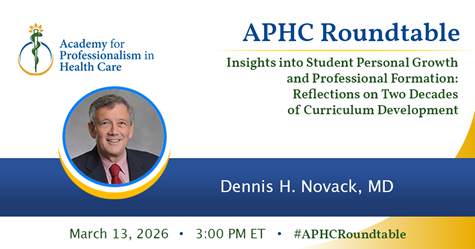
The themes discussed in the articles in this issue connect well with the upcoming Round Table on Insights into Student Personal Growth and Professional Formation by Dennis H. Novack, M.D. It is worth underscoring what a stellar Roundtable discussion this promises to be. The session is set to explore professional formation and professional identity through the lens of curriculum design and with an eye toward fostering personal and professional growth in medical students. See the second article by Amanda Brand for a nice example of a reflective piece by a current medical student on professionalism, professions, and humanism. Dr. Novack’s presentation will introduce reflective tasks embedded within a structured curricular framework that supports development throughout clinical training. The kinds of tasks which might well be supported by a “good enough” teacher, as outlined by Dr. Rajput in our lead article.
Check out the member announcements and accomplishments, consider the LEEP program, and be sure to register for the upcoming conference in June of this year.
Bryan Pilkington, PhD, is Professor of Bioethics, in the Department of Medical Sciences, at Hackensack Meridian School of Medicine, and the Editor-in-Chief of The Academy: A Forum for Conversations about Health Care Professionalism.
|
|
|
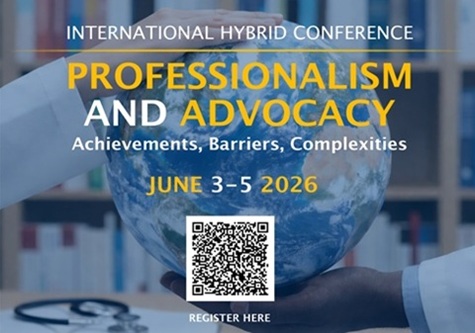
Join a vibrant, inclusive community of professionals dedicated to advancing professionalism in health-related fields at this year’s Hybrid International Conference, hosted in person at Cooper Medical School of Rowan University (Camden, NJ) and virtually via Zoom.
This dynamic event features:
- Keynote Presentations
- Symposia
- How-To Workshops
- Problem-Solving Sessions
- Expert Panels
- Oral Presentations
- Flash Presentations
All sessions are hybrid and will be recorded for on-demand access after the event.
With over 60 engaging sessions, you'll have plenty of opportunities to network and explore critical themes, including:
- Importance of Advocacy for Healthcare Professionals – Generational and Cultural Differences
- Advocacy Training Programs and Effective Teaching Methods
- When to Advocate for Patients, Learners, Co-workers?
- Self-Advocacy – A Key to Wellness and Success for Patients, Learners and Professionals
- Intra- and Inter-professional Advocacy in Teams (e.g., Priorities Negotiations)
- Who Needs Help - Patients, Providers, Systems?
- International Perspectives on the Role of Advocacy in Healthcare
- Advocacy and Professionalism: Balancing Opportunities and Boundaries
- Advocating for Justice and Peace – An Ethical Responsibility of Healthcare Professionals?
🎓 Whether you're attending in person or online, this is your chance to be part of a global conversation shaping the future of professionalism in health care.
👉 Click here to for more info
👉 Click here to register
👉 Click here for nearby hotels
|
|
|
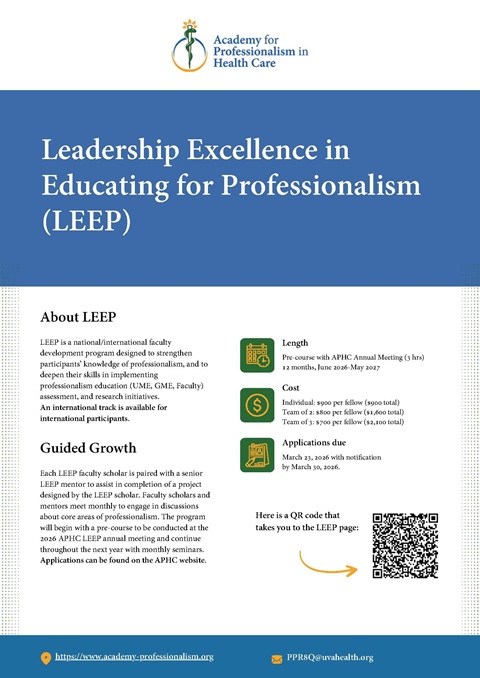
Now Accepting 2026-2027 LEEP Applications
|
The “Good-Enough Teacher” as a Professionalism Imperative in Medical Education
By: Vija Rajput
|
Medical education has appropriately elevated learner well-being, burnout prevention, and psychological safety in learning envionment. Yet in our collective effort to protect students from distress, we may be unintentionally weakening the very capacities that define professional identity formation and professionalism in medicine.
Drawing on Donald Winnicott’s concept of the “good-enough” mother and caregiver, recent scholarship and cultural commentary remind us that human development does not emerge from perfect protection but from responsive environments that allow manageable frustration, feedback, and increasing autonomy (Winnicott, 1965). As revisited in contemporary discourse, constant accommodation, protectionism, and trauma informed practice can inhibit resilience rather than foster it, producing fragility instead of growth.
Today’s well-intentioned safetyism often manifests as softened evaluations, flexible deadlines for nearly all stressors, reduced stressful clinical exposure, and avoidance of difficult feedback. These practices are frequently justified as trauma-informed and burnout-responsive. However, much like Winnicott’s overattentive caregiver, excessive educational accommodation risks depriving learners of formative struggle that allows developing clinical judgment, accountability, emotional regulation, and professional identity.
Consider a common clinical teaching scenario. A third-year student presents a differential diagnosis on rounds that is incomplete and disorganized. In the spirit of protecting confidence, the attending gently reframes the presentation, fills in missing elements, and avoids direct critique. The student leaves feeling supported—but without clarity on performance gaps or how to improve. Contrast this with a good-enough teacher who offers clear, respectful feedback: highlighting strengths, identifying specific deficiencies, and assigning focused practice. The moment may feel uncomfortable or even with some embarrassment, but it drives growth.
Or consider simulation training. When learners are shielded from cognitive overload or emotional intensity—shortened, trauma informed calibrated cases, minimal debrief challenge, failure quickly rescued—the learning experience becomes comfortable but shallow. Programs that intentionally allow learners to struggle within safe boundaries consistently produce stronger clinical reasoning and confidence.
Learning science supports this developmental truth. Research on “desirable difficulties” demonstrates that effortful retrieval, corrective feedback, and productive struggle significantly improve long-term retention, transfer of learning, and adaptive expertise (Bjork & Bjork, 2011). Comfort may feel supportive, but challenges when scaffolded can help to build competence.
Importantly, the good-enough teacher does not dismiss mental health concerns, avoid trauma informed practice or romanticize hardship. Structural contributors to burnout like excessive workload, inefficiency, mistreatment, inequity, and toxic learning environments, all require systemic reform. Protecting learners from abuse is non-negotiable. But protecting them from all discomfort is developmentally counterproductive.
The good-enough teacher instead offers calibrated support: Psychological safety without performance avoidance, compassion alongside clear expectations, flexibility when appropriate without eroding standards and feedback that is honest, timely, and growth-oriented. This balance aligns deeply with professionalism. Medicine is not merely a knowledge enterprise, it is a moral practice requiring accountability, resilience, humility, and judgment under uncertainty. When we remove all stress from training, we risk producing clinicians who are technically credentialed yet emotionally underprepared for real patient care.
We are already seeing subtle consequences. Residents increasingly report anxiety when confronted with high-stakes decisions, avoidance of feedback conversations, and discomfort with clinical uncertainty. These are not failures of character; they are predictable outcomes of educational environments that equate struggle with harm.
The solution is not a return to punitive rigor or stoic endurance culture. It is a return to developmental wisdom. Just as Winnicott showed that children thrive when caregivers gradually step back while remaining supportive, learners thrive when educators challenge while remaining present. The good-enough teacher walks alongside students through difficulty rather than clearing the path ahead of them. In an era rightly focused on compassion and well-being, medical education must resist confusing protection with formation. Professional identity is built not through perfect comfort, but through supported responsibility.
We do not need flawless teachers. We need good-enough teachers—educators courageous enough to challenge, compassionate enough to support, and wise enough to know that growth requires both.
FURTHER READING
- Bjork, E. L., & Bjork, R. A. (2011). Making things hard on yourself, but in a good way: Creating desirable difficulties to enhance learning. In M. A. Gernsbacher, R. W. Pew, L. M. Hough, & J. R. Pomerantz (Eds.), Psychology and the real world: Essays illustrating fundamental contributions to society(pp. 56–64). Worth Publishers.
- Winnicott, D. W. (1965) The Maturational Processes and the Facilitating Environment: Studies in the Theory of Emotional Development. The Maturational Processes and the Facilitating Environment: Studies in the Theory of Emotional Development 64:1-11
Vijay Rajput, MD,MACP,FRCP, Professor, Chair, Department of Medical Education, Nova Southeastern University, Dr Kiran C. Patel College of Allopathic Medicine, FL, Unites States.
Back to Table of Contents
|
What is Owed: to Patient, Self, and Colleague
By: Amanda Brand
|
Over the past decade, there has been growing skepticism and distrust of patients towards medical doctors within modern western society. Allen Buchanan’s work, “Is there a medical profession in the house?”, delves deeper into the problems doctors face as they are held to the standard that society has set for them. While the article dictates many different elements of the physician’s profession, there is subtle commentary on the increasing tendency of the term “professionalism” to be interpreted and used by society to the benefit of the elite.
Buchanan speaks about “the myth of professionalism”, an assumption that doctors, by way of the nature of their profession, are inherently altruistic and non-materialistic. He then asserts the contrary, that doctors in the modern day are instead selfish and externally motivated. They assume their profession due to the financial reward, higher status in society, and the social benefits which accompany the title.
The word "professional" originally described the refined and polished nature of a human being who assumes a job or status in society which is generally regarded by the masses to be amongst the most elite. Currently, being “professional” has become more subjective to whatever the field of work in question requires of it. For example, in medical school, the curriculum has been shifting towards a focus on “humanism”. To medical school officials, “humanism” constitutes the values that progressives in society are pushing towards in the modern age: acceptance towards all minority groups; specifically those of differing gender identity, different cognitive and physical capabilities, and those with socioeconomic insecurities or instabilities. In this sense, “humanism” has become the medical definition of "professionalism”: since doctors are supposed to care about people, and caring about people is now defined by society as being progressive, professionalism equals humanism which equals progressivity.
However, if one was talking about professionalism in the field of law, these definitions may be different due to the different expectations of society from lawyers. Lawyers are supposed to help their clients win cases, so professionalism to lawyers may mean doing whatever it takes, ethical or unethical, to help lawyers win their case. Manipulation could be tolerated in this situation, while it would not necessarily be in the medical field.
It is important to consider how these shifting definitions of professionalism influence the way future physicians internalize their roles. When students are repeatedly taught within a “hidden curriculum” that professionalism equates to whatever current social values the institution chooses to emphasize, it blurs the line between genuine moral development and simple compliance. This creates a kind of identity tension: students may feel pressure to adopt certain beliefs or behaviors not because they naturally align with their own understanding of what it means to be a good doctor, but because doing so is necessary to avoid punishment or appear “fit” for the profession. Over time, this can distort the true meaning of professionalism by rewarding performance over authenticity. What begins as an attempt to develop compassionate and ethically grounded clinicians can unintentionally turn into a system that prioritizes image, conformity, and institutional alignment rather than sincere commitment to patient care or moral responsibility.
So, in conclusion, both Allen Buchanan and I agree on the idea that professionalism moves from the field of the objective to the subjective. When a concept is subjective, it is subject to manipulation and control by those who have the power to control it. In our case, professionalism is determined by those who dictate the rules of the medical field. They are able to mold the term into whatever best suits institutional interests at a given moment. This, however, does not mean that the actual ideas of humanism, altruism, or ethical conduct are unimportant; in fact, the truth is quite the contrary. It is important, however, to recognize professionalism as a societal construct in order to ensure honest conversations and reflections about how to actually implement and practice the real characteristics of altruism and humanism without being influenced by external powerful factors. In this way, we are better able to return to that original and intended concept of “professionalism” created so long ago..
Amanda Brand, BA is a medical student at Hackensack Meridian School of Medicine pursuing a career in the field of neurology.
Back to Table of Contents
|
| |
AI-Mediated Healthcare Interactions and Thinly Veiled Normative Frameworks
By: Bryan Pilkington, PhD, Hackensack Meridian School of Medicine
|
There continues to be a significant debate over the manner, location, and task spaces in which artificial intelligence ought to be employed in healthcare. Though the use of algorithms to aid healthcare professionals in their many and time-consuming tasks is more welcome than AI replacing their human counterparts, disagreement remains. Even seemingly benign uses of AI, such as generating notes from healthcare professionals to patients, have raised ethical and professionalism-based concern. Though the fast-paced world of medical AI has moved quite far since headlines shocked patients that it was not their doctor but AI that messaged them about that ailment that had been pestering them (e.g., see the New York Times Heath section from a year or so ago, which noted, as if leaning over to you while you flipped through your MyChart, “That Message From Your Doctor? It May Have Been Drafted by A.I.”).
The topic of AI generated notes is, in some way, old news, but the contrasting claims by industry professionals, ethicists, and members of the health professions make it an interesting case for post hoc, Monday-morning-quarterback style reflection. What should interest professionalism scholars is not only the diverse perspectives that were exhibited about the merits of these responses to patients, but the distinctly different underlying normative frameworks at play in conversations about this technology; frameworks that were (and are) not always made explicit in institutional, governmental, and social policies, but which do the philosophical heavy lifting in the underlying arguments. This is not necessarily the fault of industry or healthcare professionals – or even of professionalism scholars – we don’t all walk around noting our ethical commitments or sharing the costs and benefits of approaches to particular problems we encounter from our preferred moral-professional lenses. However, it may be useful to highlight a few of those distinct approaches and connect them to commonly held views about the role of AI in medicine and in medical communication to see whether the apparent disagreements might be resolvable or, at least, if the strong language employed throughout the debate might offer lessons for thinking about the role of medical AI currently and in the future.
Consider three such frameworks. First, Athmeya Jayaram of the Hastings Center has argued that patients would feel betrayed, and justifiably so, if they were to discover that an algorithm generated a response to their query of a physician – even if that response were edited by the physician to whom they reached out. This perspective is grounded in a particular vision of medicine – one that holds the relationship between patient and provider as deeply valuable, if not sacred. But is this relationship still operative in modern medicine? Are the norms associated with it still viable? It is a relationship that I find both important and tremendously interesting – enough so to have lured me, some years ago, to the study of medical ethics and away from other philosophical questions about freedom of the will and moral responsibility. Yet, I’m not convinced that that relationship exists today as it once did. Patients are not always seen by physicians but rather seek care at institutions. It is not Dr. Jayaram, say, who addressed my professionalism lapse consult or who saw to my moral maladies, but rather I went to the Hastings Center or the APHC conference for assistance in navigating my ethical and professionalism issues, respectively. In fact, the shift to group practices, extensive information sharing (even within HIPAA-compliant platforms), and simply the sheer number of persons involved in patient care led famed University of Chicago medical ethicist Mark Seigler to describe confidentiality – one of those most enshrined norms of Hippocratic medicine, dating back to the itinerant nature of physicians who treated patients within the latter’s home, viewing a host of personal matters about which they must keep silent – as a “decrepit” concept, and that was over four decades ago. Jayaram is right that the AI generated response is a betrayal, but not of the patient today; rather, it is a betrayal of the patient within a certain context, a context which may no longer exist.
Jayaram’s assertion is not the only big claim rooted in a more well thought out, but thinly veiled, ethical approach. In addition to an approach rooted in the norms of a physician-patient relationship, another popular lens for viewing issues of healthcare and AI is broadly consequentialist. Some had argued against disclosure of the use of AI in messages because they believe it cheapens the medical advice in those messages. One proponent of this view is Paul Testa, Chief Medical Information Officer at NYU Langone. This view justifies an informational policy that is tantamount to intentional dishonesty, but does so due to the belief that it is ultimately better for patients to receive sound advice and follow it, regardless of its source, than to not follow such advice. The intentions are good, the aims admirable; however, medicine has long housed debates over freedom and best interest, and even for those of us who think the pendulum has swung a bit too far into the autonomy-above-all-else direction, justifying deception because the results are better for the patient is not something that is generally accepted as a practicing with professionalism. It either falls to critiques of paternalism or to simply prudential considerations associated with trust.
Simply disclosing the role of AI generated content in exchanges alleviates a number of worries – it may allow for the retention of trust in a relationship that, for better or worse, appears to be dissipating (or, at least, changing); it may aid in building (or re-building) trust among patients and practitioners when many within the former category have been deceived by many in the latter category, at least often enough to make research ethics an enterprise; and it fits common disclosures patients see in other aspects of their lives. Such disclosures need not, but often do, follow from a rule-based framework – a deontological, autonomy-focused approach may be in the minds of those who favor transparency. One such proponent, with respect to the practice of AI-generated notes, is Christopher Longhurst, Chief Clinical & Innovation Officer at UC San Diego Health. This approach comes with the costs of explaining to patients what exactly is occurring in these messages, risking confusion and raising the possibility of worse outcomes – fitting the form of a critique common to rule-based ethical and professionalism approaches when adherence to rules undermines some of the goals of the practices of those who bind themselves by such rules. Disclosure can lead to challenging conversations if patients are to be informed of (if not consented for) these practices.
Further, disclosure does not alleviate all relevant issues: patients may seek out empathetic providers and such persons are probably not letting an algorithm connect with their patients in one of the potentially few remaining authentically human interactions in medicine. But – contrary to studies that have argued that AI is more empathetic than humans, it is not – the key is not about what is empathic or not, but rather what is perceived by patients as empathetic. It is perception that matters here, especially if the tool is employed as an initial drafter with the physician editing, approving, and – ultimately – signing their name to a response. This last point is not a small one. Errors (including significant ones) occur and not infrequently, at least according to research published in the New York Times. Yet, what is most important is not the frequency – though that surely matters – but the kind of error that occurs. If AI generated notes regularly mix up the dates of future appointments, physicians can look out for that; the costs of missing the error are significant inconveniences more than substantial harms. However, other mistakes are greater and, as was illustrated in a somewhat recent study, they are the kinds of mistakes that connect to deeply held values of human beings; that is, they matter because they matter to us. In that study, it was found that though the models under consideration “passed the test” – answering well (and justifying answers to) ethics questions intended to test medical students – the mistakes made, even when rare, were unacceptable. Models ignored, for example, cases of child abuse, focusing instead on who might consent for a young patient.
The use of AI in answering queries from patients may seem like a small and dated topic, but it signifies a watershed moment in medicine. If we are to retain or return to a previously common understanding of healthcare professionalism rooted in that almost sacred relationship, care must be taken with the places and spaces that sit between members of that relationship. If that moment has passed, regulation to rein in those who would opt for deception with eyes only to perceived best outcomes is sorely needed and may yet be possible. And if the technologies continue to mediate and influence the interactions between parties to that relationship, significant checks need to be put in place to correct especially those rare yet humanly weighty errors. Healthcare professionals, as well as professionalism scholars, advocates, and teachers, in light of their familiarity with professionalism and with the normative frameworks that appear to be operative in various positions debate over the role of AI in mediating interactions between patients and professionals, are well placed to assist in disarticulating these theoretical underpinnings to help highlight the costs and benefits of policies and practices of AI generated work.
Bryan Pilkington, PhD, is Professor of Bioethics, in the Department of Medical Sciences, at Hackensack Meridian School of Medicine, and the Editor-in-Chief of The Academy: A Forum for Conversations about Health Care Professionalism.
Back to Table of Contents
|
|
|
|
Professional identity formation is shaped not only by what clinicians learn and do, but also by how they relate to themselves, particularly in moments of challenge, uncertainty, and perceived failure. Emotional resilience is not a fixed trait, but a skill that can be intentionally cultivated. Self-compassion offers a practical and This Roundtable session will explore professional formation and professional identity through the lens of curriculum design aimed at fostering personal and professional growth in medical students. The presentation introduces reflective tasks embedded within a structured curricular framework that supports development throughout clinical training. The interactive Roundtable format emphasizes shared experiences, practical application, and open discussion to promote reflection, resilience, and the formation of a strong professional identity.
About the Presenter:
Dennis H. Novack, M.D.
Professor of Medicine
Associate Dean for Clinical Education and Assessment
Drexel University College of Medicine
Register at: https://tinyurl.com/2026Roundtables
Roundtables are for APHC Members only.
Check out our membership benefits here.
Join APHC to access previous Roundtable recordings.
Back to Table of Contents
|
Healthcare Professionalism: Education, Research & Resources Podcast
|
Professional Formation and APHC collaborate on a podcast, Healthcare Professionalism: Education, Research & Resources.
Over 125 podcast episodes have been released with over 17,000 downloads.
Released every other Saturday morning, recent episodes include Rachel Pittmann discussing Telehealth Etiquette and Amal Khidir talking about Designing the Faculty Development Professionalism Program with Multi-cultural Perspectives.
You can access the podcast episodes on your favorite platform or at: https://bit.ly/PF-APHC-Podcast
Back to Table of Contents
|
APHC Member Announcements
|
If you are an APHC member, we will publicize your events, job searches, research, grants, articles, podcasts, books, etc., in the newsletter.
Back to Table of Contents
|
As a member, you have access to special benefits that include:
- Belonging to a community of like-minded professionals
- Participating in the monthly Professionalism Education
Roundtables with authors, faculty, and researchers, plus accessing past recordings
- Accessing 15 Professional Formation modules for individuals for free
- Enrolling in the APHC Faculty Development Certificate program known as LEEP (Leadership Excellence in Educating for Professionalism), which was launched in 2020 and offers longitudinal mentoring for a select group of
individuals seeking to deepen their knowledge and skills in
professionalism education, assessment, and research
- Posting your research, articles, podcasts, webinars, conferences, and books in the newsletter distributed to about 15,000 people
- Receiving a 20% discount on educational videos created by the Medical Professionalism Project, which also allows you to obtain MOC and CME
- Registering for APHC conferences with discounts
- Participating in APHC committees, which include the conference program, membership, and education committees
Our annual membership fees are very inexpensive and are valid for one year from the payment date. Select from seven types of membership, including the institutional membership for four people. See the descriptions.
Back to Table of Contents
|
The Academy Newsletter Editors
|
Editor-in-Chief: Bryan Pilkington | Managing Editor: Yvonne Kriss
Please contact Yvonne if you'd like to contribute an article to this newsletter.
If you know someone who would benefit from reading Professional Formation Update, please pass this along. They can subscribe to the newsletter by clicking here.
|
Academy for Professionalism in Health Care
PO Box 20031 | Scranton, PA 18502
|
Follow us on social media.
|
|