Volume 9, Issue 1 - January 2026
|
Professionalism: History, Ethics, and Applications
By: Bryan Pilkington, PhD
|
This first issue of The Academy for 2026 highlights the length and breadth of topics impacting important discussions of health professionalism. As those in some locales – due to changing governmental regulations, policies, and programs – have seen the road to becoming a health professional made much, much bumpier, we consider topics in both of historical- and forwarding- natures, as well as work in professionalism-adjacent spaces.
In “Prescriptions Fade, but the Spirit Remains: A Legacy of the Hippocratic Oath,” Guy Stein reflects on the influence of the Hippocratic Oath, arguably the single most important document to the profession that he holds most dear. Whether the Oath is appropriately applicable in modern professionalism contexts is an important question to consider for future physicians, as well as for all health professionals whose work is impacted or whose profession’s core values have been influenced by the content of the Oath. Gazing back in our first article, we look forward in our final article, by Milan Kharel. Dr. Kharel examines the National Health Service’s Virtual Wards, which raise interesting and timely questions about the application of health professionalism in novel spaces. These questions call out for answers, and so we invite those who are thinking about the application of professionalism in new spaces, to share their thoughts (to be considered for publication in the Letters to the Editor section of our February issue). Bridging the gap between the past and the future is our second article, penned by Tom Koch. Koch reflects on professionalism and the philosophies of care through a critical examination of the intersection of the field of bioethics and professionalism. There are lessons to be drawn from his historically informed work, and - as with our final piece - we invite readers, especially those with interests in bioethics, to write to us with any reactions to Koch’s arguments. His pithy title, “After Bioethics: The Professional and Philosophies of Care,” harkens back to work in the discipline of philosophy, like Alasdair MacIntyre’s After Virtue: A Study in Moral Theory, as well as work in bioethics, such as H. Tristram Engelhardt’s After God: Morality and Bioethics, and it will not disappoint the reader interested in a critical evaluation of a field so impactful on health professionalism.
Also included in our monthly publication are important updates about future professionalism conversations, most noteworthy the APHC’s upcoming conference, as well as our usual set of announcements both from members and about professionalism-related opportunities.
Bryan Pilkington, PhD, is Professor of Bioethics, in the Department of Medical Sciences, at Hackensack Meridian School of Medicine, and the Editor-in-Chief of The Academy: A Forum for Conversations about Health Care Professionalism.
|
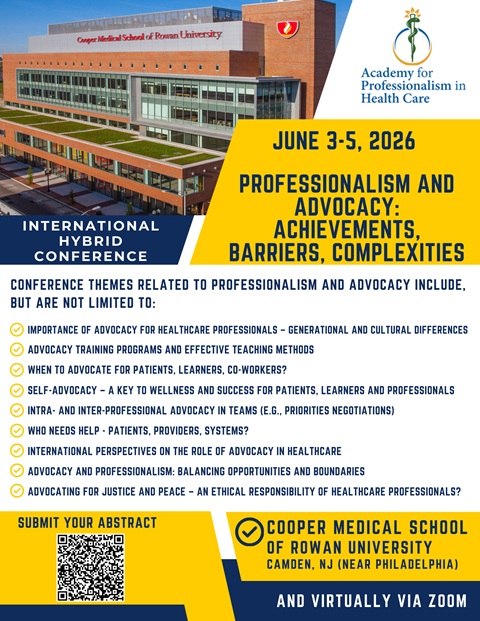
Call for Abstracts: APHC International Hybrid Conference June 3-5, 2026
Via Zoom and at Cooper Medical School of Rowan University
|
Prescriptions Fade, but the Spirit Remains: A Legacy of the Hippocratic Oath
By: Guy Stein
|
In Western culture, the Hippocratic Oath is often regarded as a foundational text of the medical profession. Since its inception more than 2,000 years ago, the medical profession has changed dramatically and in turn so has the oath that most physicians may take today. One of the most common iterations of taking the oath these days is doing so in medical school ceremonies. Some institutions have changed the Oath to reflect their values, while others use popular updated versions. A 2009 survey found that one-third of U.S. and Canadian schools used Dr. Louis Lasagna’s modernized version, while only 11% retained the original.1 In a 2016 survey, 70% of physicians over age 65 found the oath meaningful, compared with just 39% of those under 34.2 This generational divide raises the question: why does the oath resonate less with younger physicians?
First, the original text is bound to its historical context. It references Greek gods, forbids sexual acts with slaves, and other elements which are irrelevant to modern medicine. More significantly, the oath embodies a paternalistic model of the patient–physician relationship. While it prohibits harm through malpractice, sexual misconduct, or breaches of confidentiality, it never acknowledges patient autonomy. Modern medicine, however, is grounded in shared decision-making, with autonomy considered a central ethical principle. The importance of this principle is even more prevalent in younger physicians, and the oath’s silence on this point undermines its relevance.
Second, the oath ignores preventive medicine, a cornerstone of modern practice. Screening tests, vaccinations, and lifestyle interventions are widely regarded as essential to reducing disease burden on both the individual and the general population. Physicians strongly support prevention, yet the oath reflects only treatment of disease, not proactive care. Since the time of Hippocrates, medicine has expanded to include population health alongside individual patient care. This evolution is evident in public health campaigns that keep both communities and individuals healthier while reducing the overall burden on healthcare systems. The omission of prevention from the oath further distances it from modern medical professional values.
Third, the oath’s stance on abortion and end-of-life care underscores how opinions in medicine have changed. The original bans abortion outright, while modern versions omit this restriction.3 Lasagna’s version even acknowledges a physician’s potential role in ending life, tempered by humility: “Above all, I must not play at God”.1 This reflects evolving debates around abortion and medical assistance in dying. While not all physicians agree with such practices, the acknowledgment of these responsibilities marks a significant departure from the Hippocratic prohibition. The diversity of views on these issues illustrates the ethical complexity of modern medicine and the inherent limitation of any single oath to capture the full spectrum of opinions. Together, these omissions and revisions explain why younger physicians, who are trained in a profession centered on autonomy, prevention, and contested practices like assisted dying, see the original oath as outdated.
Still, the oath’s influence persists. Even revised versions retain the original spirit and structure. The original emphasized obligations to teachers and colleagues, fostering camaraderie and continuity within the profession. While the specifics (such as offering free education to one’s teacher’s children) no longer apply, the modern oath echoes this sentiment: “I will respect the hard-won scientific gains of those physicians in whose steps I walk, and gladly share such knowledge as is mine with those who are to follow”.1 Mentorship and collegiality remain pillars of medical life, setting medicine apart from many other professions.
Most importantly, the oath enshrines the ethic of doing good for patients and avoiding harm. Though approaches to achieving this have changed, the central ideal remains constant. Hippocrates’ specific prescriptions may have faded, but the oath codified an enduring professional identity.
As I enter the fourth year of my medical training, I find that the spirit of the oath still resonates with me. When I took the oath during my first year of medical school I found the wording to be obvious, and the content to be straightforward. I thought to myself: how could we need to take this oath (the revised version) when anyone who knows anything about medicine would assume these values? Yet, as I reflect on those initial impressions, I realize that the apparent obviousness of the oath is a testament to its ubiquity in the modern consciousness regarding what it truly means to be a physician.
In short, the Hippocratic Oath is no longer directly applicable as a literal guide for practice. Its content reflects an ancient worldview far removed from contemporary medicine. Yet its legacy endures: it established the expectation that physicians articulate and commit to an ethical framework beyond technical skill. For that reason, even if younger physicians find the oath’s literal wording outdated, they remain heirs to its lasting spirit.
REFERENCES
- Hajar R. The Physician's Oath: Historical Perspectives. Heart Views. 2017;18(4):154-159. doi:10.4103/HEARTVIEWS.HEARTVIEWS_131_17
- Meskó B, Spiegel B. A Revised Hippocratic Oath for the Era of Digital Health. J Med Internet Res. 2022;24(9):e39177. Published 2022 Sep 7. doi:10.2196/39177
- T.A. Cavanaugh. Hippocrates’ Oath and Asclepius’ Snake : The Birth of a Medical Profession. Oxford University Press; 2018. Accessed September 12, 2025. https://research.ebsco.com/linkprocessor/plink?id=f87ee42f-d7bf-3ad0-b21a-7dcbdf51a0a4
Guy Stein is a current fourth year medical student at the Hackensack Meridian School of Medicine with an interest in Internal Medicine.
Back to Table of Contents
|
After Bioethics: The Professional and Philosophies of Care
By: Tom Koch
|
Bioethics came on the scene in the 1970s like a slick, television campaigner announcing answers for a problem nobody knew existed. Medicinal advances, its promoters declared, required a new ethic and moral philosophers had the answer (Beauchamp and Childress 1979,1).
All that was needed was “philosophical reflection on morality and ethics … that affords some distance from assumptions still evident in the biomedical sciences and healthcare”. Forget the old, Hippocratic tradition. Founding bioethicists would set forth a limited series of general principles to govern medicine in the future. With their application it would all work out.
At the recent meetings of the American Society for Bioethics and the Humanities (ASBH) there was talk of AI and ethics, clinical ethics, genomic ethics, global healthcare, neuroethics and religious ethics—everything but Bioethics and its principles that were supposed to provide answers to every query.
Certainly, an ethics of practice with a social vision of health care is needed. Bioethics was a grand ideal (Koch 2008) that failed to provide either in three essential ways. In thinking about medical ethics today it’s useful to remember that there were at least three other potential ethical systems that might have served at least as well, or better. Here they are reviewed as a palliative to Bioethics failures.
The Failure
First, was the perhaps arrogant assumption that moral philosophers with neither medical experience or training in socioeconomic practice might craft a simple set of principles that could govern the complexities of clinical practice and health policy.
“Philosophy cannot do its job well unless it is informed by fact and experience” (Nussbaum 1998). Moral philosophers had neither. Little wonder that, as Hastings Centre cofounder Daniel Callahan later admitted, “We felt most like the wizard [of Oz], pulling levers behind a screen and talking in a way that projected a wisdom about large moral puzzles we did not yet have” (Callahan 2012, 77).
Second, Bioethicists ceded questions of medical organization and governance to a commercial vision in which medicine was less an ethical good than a product, embracing a traditional view that the market encompasses most desired transactions (Radin 1996, 36).
And so for bioethicists, “The market was treated as a moral, not just an efficiency value … little interested in the common good” (Callahan 2012, 132-33).
That fit nicely with the neoliberal, Regan-Thatcher economics of the day. It was “the sell,” perhaps heart-felt but also practical and self-serving. As former ASBH director Mark Kuczewski admitted, “Ethicists have been a guest in the house of medicine,’ and in order to survive in that environment have had to align themselves with money and power” (Kuzczewski 2010, 4).
The result has been, as Callahan eventually admitted, “devastating” (Callahan 2012, 127).
Third, for Bioethics to succeed it needed to push religion as a value system and practitioners as ethical experts (CALLAHAN 1993, S8-9). Robert Veatch (2912) insisted medical professionals were merely technicians with no more moral understanding than a store clerk recommending, say, a new pair of shoes. That was consistent with the patient-as-consumer view “turning professionals into sellers”(Mol 2002, 167).
Fourth, Bioethicists advanced “autonomy” as its governing principle. That dismissed the traditional, relational ethic of medicine as a shared endeavour between practitioners and patients with practitioners serving as active agents for a caring healthy environment.
The Bioethical vision was wrapped into that of Professionalism as a mostly silent, powerless partner in an unwritten, unnegotiated contract with business and government. The result has been to limit their role as ethicists and citizens focused on justice and care even as in practice they remain Hippocratic in their duties to patients. It is no wonder either that the result has been diminished respect for the practitioner in a commercialized environment that is less amenable to fulfilling ideals of equality and justice.
Alternatives
Any corrective to Bioethics would require, first, a move back toward a relational and communal ethic of care (Elliott 2021). Certainly any such move would revive the focus on the medical practitioner-patient relationship. The Hippocratic injunctions in its Oath included benevolence, nonmalevolence … and justice as practical duties:
“Into whatsoever houses I enter, I will enter to help the sick, and I will abstain from all intentional wrong-doing and harm, especially from abusing the bodies of man or woman, bond or free” (Jones 1923).
That vision would have been embraced by the post World War II existentialists like Jean-Paul Sarte and Simon de Beauvior. Moral philosophers, they rejected the abstract for the practical and immediate with Husserl’s battle cry: “To the Things themselves”.
For them, the patient in relation was the phoneme of ethical human endeavour, one including social engagement and justice.
As Bioethics dismissed the practically relational another ethic was developing in the 1980s. Like the existential and the Hippocratic, it, too, was grounded in the realities of interpersonal caring. Feminist ethics “calls upon us to take responsibility while liberal individualistic morality focuses on how we should each leave each other alone” (Held 2006, 4-5).
Conclusion
One cannot un-ring the bell. Bioethics remains a broad forum for all sorts of topics. But for professionals requiring an ethics of care, a new ethic is required, one that like the traditional Hippocratic ethic, the existential turn and feminism, one that is relational from the start. That ethics of medicine would embrace the activism Bioethics ignored (“bioethics has not turned out many Ralph Naders”, Callahan 1993) and a sense of both life and care as essential goods.
REFERENCES
Callahan D. 1992. Why America accepted bioethics. The Hastings Center Report 23: S8-9.
Callahan D. 2012. In Search of the Good: A Life in Bioethics. Cambridge, MA. MIT Press.
Elliott C. 2021. Sisyphus Gets a Prescription. Hedgehog Review 23 (3). https://hedgehogreview.com/issues/authenticity/articles/Sisyphus-gets-a-prescription.
Held V. 2006. The Ethics of Care: Personal, Political, and Global. NY: Oxford University Press.
Jones W.H.S. 1923. “The Oath.” Hippocrates of Cos. Loeb Classical Library. 147: 298–299.
Koch T. 2008. Bioethics? A Grand Idea. J. of the Canadian Medical Association 178.1, 116.
Kuczewski M. G. 2010. Taking it Personally: Reflections on Living Bioethics and Medical Humanities. ASBH Reader (Summer-Autumn): 4.
Lasagna l. 1991. Mortal Decisions: The Search for an Ethical Policy on Allocating Health Care. Science 120 (3114): 43-44.199.
Nussbaum M. 1998. Public Philosophy and international Feminism. Ethics 108: 762-68.
Radin M. A. 1996. Contested Commodities: The Trouble with Trade in Sex, Children, Body Parts, and Other Things. Cambridge, MA: Harvard University Press.
Veatch R. 2012. Hippocratic, Religious and Secular Medical Ethics: The Points of Conflict. Washington, DC: Georgetown University Press.
Tom Koch (http://kochworks.com) is a medical ethicist, gerontologist, geographer and historian. He is the author of more than 200 articles and Thieves of Virtue: When Bioethics Stole Medicine (2012) and recently Seeking Medicine’s Moral Centre (2024).
Back to Table of Contents
|
| |
The National Health Service’s New Virtual Wards
By: Dr. Milan Kharel
|
Introduction
In recent years, the National Health Service (NHS) in England has invested in the concept of virtual wards, home-based care supported by digital technologies, and multi-disciplinary teams working outside the hospital wards. As this shift unfolds, it offers fertile areas for reflection on professionalism in health care: how clinicians adapt their roles, how inter-professional relationships change, and how the social contract between the profession and society is remodeled.
Change in professional roles in the virtual ward
In a virtual-ward model, patients remain at home or in community settings while clinicians monitor vital signs, symptoms and progress via digital platforms, visit the patient at home (or by telephone calls), and coordinate care remotely. This transformation challenges traditional practice of “inpatient ward care”- the physical ward, rounds, and face-to-face interaction. For professionals accustomed to the hospital environment, this shift demands recalibrating the ethical, relational and practical dimensions of their practice.
From a professionalism lens, three inter-related domains come to the fore:
- Professional autonomy and responsibility - Clinicians in virtual wards must exercise judgments when data arrive from patients’ homes: what triggers a home visit, when to escalate, when to rely on remote monitoring alone. The responsibility to safeguard patient welfare remains unchanged, yet the environment is radically different. Professionals must still act with accountability and transparency.
- Communication and relationships - The virtual ward may reduce the frequency of in-person clinician-patient contact which raises questions about how trust is built and sustained. How do professionals demonstrate empathy virtually? Professionalism demands that we attend to relational quality- not just clinical practice. The team dynamic also shifts: home visits, remote monitoring, digital communication, and community links require flexible, collaborative inter-professional relationships.
- Patient-centredness - The NHS’s drive for virtual wards is motivated by the need to free hospital capacity, reduce length of stay, and improve throughput. These are visible goals. Yet from a professionalism perspective, we must ask: Do virtual wards serve all patients equally? Do patients at home have the environment, technology access, digital literacy, and social support needed to thrive in such a model? The social contract between the professions and the public requires that innovations in care don’t widen disparities or replace human connection with cold monitoring.
Current scenario of Data and scale
To quantify our topic let us consider the data:
- Until March 2025, there were approximately 20 virtual ward “beds” per 100,000 GP-registered people in England [1].
- Until December 2023, virtual wards in England achieved an occupancy rate of just under 73 percent, which is equivalent to around 8,600 patients being cared for in virtual beds at that time [2].
- The NHS England data are now collected via monthly Situation Reports covering capacity, occupancy percentage, and capacity per 100,000 population from July 2023 onwards [3].
- The NHS operational framework that focuses on virtual wards is currently available in every Integrated Care System (ICS) in England [4].
These numbers indicate that virtual wards are no longer a new niche: they are a system-wide, scaled intervention. But scaling also raises questions: 73 percent occupancy suggests unused capacity remains, and variation across systems suggests unequal maturity. For professionals, this means we are still in transition- both in service delivery and in professional roles.
Implications for the clinicians
Although virtual wards offer opportunities, they also bring risks for professional practice. On the positive side, it may empower professionals to engage patients in their homes, promote continuity and holistic care, reduce hospital-induced risks (such as infections and deconditioning), and encourage more flexible working models.
On the contrary, clinicians may feel detached from the traditional “ward based culture". There is the risk of over-dependence on devices and data, at the expense of interpersonal judgement and the formulation of medicine and nursing.
Need to thoughtfully integrate professionalism in virtual care
As NHS systems continue to scale up virtual-ward, three guiding principles rooted in professionalism are worth highlighting:
- Embed relational care as core. Training in remote communication, home-based assessment, and digital empathy should form part of professional development. Virtual wards must not become purely technical or remote; they should be designed to preserve and enhance the clinician–patient relationship.
- Promote inter-professional collaboration and shared leadership. Virtual-ward models require multiple disciplines in the roles that accompany them - nurses, advanced practitioners, physiotherapists, pharmacists, digital-monitoring staff, and community workers must coordinate seamlessly. This demands clarification of roles and responsibilities, respect and leadership.
- Ensure equality and patient choice. Professionals should work for patient choice regarding virtual-ward care, and ensure those included in virtual wards are supported in ways that preserve safety and dignity.
In Conclusion
Virtual wards in the NHS represent more than a technological shift; they indicate a transformation in how health practitioners work, interact, and fulfil their roles to patients and society. For the clinicians, this marks a moment of reflection and opportunity-to reaffirm that professionalism resides not in place (the ward) but in purpose, values, and relationship. As we move on, we must carry forward the timeless commitments of care, respect, and accountability.
REFERENCES
- UK Parliamentary Office of Science and Technology. POST note 744: Virtual Wards in England. London: UK Parliament; 2025.
- The Health Foundation. What Do Virtual Wards Look Like in England? London: The Health Foundation; 2024.
- NHS England. Virtual Ward Statistics – Monthly Situation Reports. NHS England; 2024.
- NHS England. Virtual Wards Operational Framework. NHS England; 2024.
Milan Kharel, MBBS is a GMC-registered doctor and Junior Clinical Fellow in Acute Medicine at the Royal Free London NHS Foundation Trust.
Back to Table of Contents
|
|
APHC Roundtable
Friday, February 13 at 3 p.m. ET
|
Healthcare Professionalism: Education, Research & Resources Podcast
|
Professional Formation and APHC collaborate on a podcast, Healthcare Professionalism: Education, Research & Resources.
Over 125 podcast episodes have been released with over 17,000 downloads.
Released every other Saturday morning, recent episodes include Rachel Pittmann discussing Telehealth Etiquette and Amal Khidir talking about Designing the Faculty Development Professionalism Program with Multi-cultural Perspectives.
You can access the podcast episodes on your favorite platform or at: https://bit.ly/PF-APHC-Podcast
Back to Table of Contents
|
APHC Member Announcements
|
APHC Member Sofica Bistriceanu was recently named in the top 50 Disruptor List, CEO Scoop., Jan 2026. Read article here ➜
Michelle Schmude, EdD, MBA, APHC President and Geisinger Professor of Medical Education and her colleagues Dr. Andrea DiMattia, Andrea Mulrine, and Stephen Hoover had “Recommendations and Action Steps to Deploy AI in Medical Education: A Practical Guide for Responsible Integration Using the Josiah Macy Jr. Foundation Framework” published in AAMC Advancing AI Across Academic Medicine Resource Collection. Recommendations and Action Steps to Deploy AI in Medical Education: A Practical Guide for Responsible Integration Using the Josiah Macy Jr. Foundation Framework | AAMC
If you are an APHC member, we will publicize your events, job searches, research, grants, articles, podcasts, books, etc., in the newsletter.
Back to Table of Contents
|
As a member, you have access to special benefits that include:
- Belonging to a community of like-minded professionals
- Participating in the monthly Professionalism Education
Roundtables with authors, faculty, and researchers, plus accessing past recordings
- Accessing 15 Professional Formation modules for individuals for free
- Enrolling in the APHC Faculty Development Certificate program known as LEEP (Leadership Excellence in Educating for Professionalism), which was launched in 2020 and offers longitudinal mentoring for a select group of
individuals seeking to deepen their knowledge and skills in
professionalism education, assessment, and research
- Posting your research, articles, podcasts, webinars, conferences, and books in the newsletter distributed to about 15,000 people
- Receiving a 20% discount on educational videos created by the Medical Professionalism Project, which also allows you to obtain MOC and CME
- Registering for APHC conferences with discounts
- Participating in APHC committees, which include the conference program, membership, and education committees
Our annual membership fees are very inexpensive and are valid for one year from the payment date. Select from seven types of membership, including the institutional membership for four people. See the descriptions.
Back to Table of Contents
|
The Academy Newsletter Editors
|
Editor-in-Chief: Bryan Pilkington | Managing Editor: Yvonne Kriss
Please contact Yvonne if you'd like to contribute an article to this newsletter.
If you know someone who would benefit from reading Professional Formation Update, please pass this along. They can subscribe to the newsletter by clicking here.
|
Academy for Professionalism in Health Care
PO Box 20031 | Scranton, PA 18502
|
Follow us on social media.
|
|