Volume 9, Issue 7 - July/August 2026
|
Erratum: The Summer Issue: Of Conferences, Professions, and Transitions
By: Bryan Pilkington, PhD
|
The Summer Issue of The Academy covers a breadth of terrain, with our usual set of articles, as well as some shorter pieces of writing, all of which would be as well digested on a beach as in an office, break room, or classroom. I appreciate your indulgence of a second appearance of The Academy in your mailbox; the wrong version of our second article was inadvertently shared. Please see below for the correct version with my apologies to the author, Fred Hafferty, and to the reader if you’ve already looked at the Summer Issue.
The first article in this issue, “Beyond Competence: Moral Formation, the Hidden Curriculum, and Readiness for Surgical Practice,” by Kush Desai, raises important issues about professionalism and medical training. Desai engages the age-old set of questions around readiness for practice and what exactly it is that moves a trainee into the space of a full professional. Desai argues that there is a moral component, which is essential for a professional. In the surgical space, he highlights restraint as that key ability or trait, which might mark out a morally ready surgeon, as opposed to simply a competent one. This thoughtful piece will – no doubt – lead to letters to the editor.
Fittingly, our first article engages work on the hidden curriculum, referencing the author of our second article, Fred Hafferty. In “Professionalism 2.0: A Call to De-balkanizing the Academic Medical Literature on Professionalism,” Hafferty draws our attention to the set of related and potentially overlapping categories tied to health care professionalism (or, better, of which professionalism is). Where does “ethics” begin and “professionalism” end? What of “professional ethics?” Clarity around these categories, related concepts, and where overlap exists is important, and Hafferty has done our community a service in calling attention (or refocusing our gaze) toward these questions. How we think about professionalism questions or topics is impacted by – to stretch an already overly used metaphor – the lens through which we view them. A professionalism lapse that is also an ethical or moral failure may carry more significant weight and require greater redress. A supererogatory feat might be professionally laudable, but not fall into common understandings of what it is to be a professional. That is to say that the categories and where they touch or overlap others matters (both for clarity’s sake, but also) because the normative implications are influenced by our background theories and assumptions (which are often connected to those theories).
The final article in this issue is a helpful piece by this summer’s conference organizers, Elizabeth Kachur, Mary Kollmer Horton, and Amal Khidir. The article pulls together themes from the APHC’s June conference and foreshadows the upcoming online conference. It closes with a call for presentations. Do consider submitting a formal CFP (more info here).
And be sure to check out the member announcements and accomplishments area, our new (ish) Letters to the Editor section (consider penning one of your own), and information about registering for the conference. In fact, there are two letters of note. Drs. Sexson and Bell offer a provocative stance on global health and professionalism, calling our community to action. The second letter, and a fitting way to close out the summer, is with a farewell note from our (now) Immediate Past President, Dr. Michelle Schmude. Michelle has led the organization with a deft hand and had some poignant words for us to reflect on. Look out for the bookend to Michelle’s note next month, when Dr. Tanja Adonizio writes to tell us about her plans for the organization’s future.
Bryan Pilkington, PhD, is Professor of Bioethics, in the Department of Medical Sciences, at Hackensack Meridian School of Medicine, and the Editor-in-Chief of The Academy: A Forum for Conversations about Health Care Professionalism.
|
APHC Call for Abstracts Now Open (Deadline Sept. 7)
|
|
APHC is an inclusive international organization that welcomes professionals and trainees devoted to the study and advancement of professionalism in health-related fields.
This virtual conference, held via Zoom on December 2–3, 2026, will explore the theme “Professionalism: Creating a Shared Framework Across Cultures, Education, and Practice.”
In addition to the presentations and sessions selected through this Call for Proposals, the conference will feature warm-ups, keynote presentations, symposia, and ample opportunities to network with colleagues.
The submission deadline is Monday, September 7, 2026, at 11:59 p.m. ET.
Learn more and submit a proposal:
2026 December Abstract Submission
Conference Co-chairs
Elizabeth Kachur
Mary Horton
Amal Khidir
Back to Table of Contents
|
|
|
Beyond Competence: Moral Formation, the Hidden Curriculum, and Readiness for Surgical Practice
By: Kush Desai
|
Medical education measures competence with remarkable precision. We quantify operative volume, complication rates, in-training exam percentiles, and milestone progression. A graduating surgical resident can demonstrate mastery of anatomy, procedural technique, and clinical management algorithms. Yet beneath these measurable achievements lies a deeper question: how do we know when a physician is ready to wield surgical authority within moral boundaries?
In his treatment of the Hippocratic Oath, Cavanaugh argues that medicine is not merely a technique but a vowed moral practice. The Oath does not simply regulate behavior; it defines medicine’s purpose. Physicians are not neutral technicians applying tools upon demand, but professionals bound to an intrinsic good: healing. If this is true, readiness for independent practice cannot be assessed solely by technical competence. It must include formation of character. Skill can be tested; character resists quantification. This exposes a central challenge of modern medical education: we excel at transmitting knowledge, yet we are less certain how to cultivate moral boundaries that sustain a profession.
Cavanaugh’s distinction between technique (techne) and profession clarifies what is at stake. Technique is morally neutral. Grammarians can craft beautiful sentences or intentionally flawed ones; the skill itself has no inherent moral direction. A profession, however, is intrinsically ordered toward a good. The Hippocratic physician cannot intentionally harm while remaining faithful to medicine’s identity. The Oath binds the physician to a moral orientation that precedes patient preference, institutional incentive, or personal ambition. Medicine governs itself according to internal ethical commitments rather than solely external regulation.
If medicine possesses such intrinsic moral direction, education must do more than prepare trainees to perform procedures safely. It must form practitioners who understand the boundaries of their power. Surgery makes this imperative unmistakable. To operate is to invade the body and risk harm in pursuit of healing. The scalpel is a technical instrument; its moral meaning depends upon the character of who wields it. What would flawless dexterity and encyclopedic knowledge be without prudence, humility, or restraint? As technological capability expands, temptation grows to equate possibility with permissibility. Unformed surgeons ask, “Can I do this?” Formed surgeons also ask, “Should I?”
How, then, is such formation achieved? Frederic Hafferty’s The Hidden Curriculum in Health Professional Education offers crucial insight. Hafferty argues that professional identity is shaped less by formal instruction than by implicit values embedded in institutional culture. The “hidden curriculum” consists of lessons conveyed through hierarchy, evaluation systems, language, and daily practice. Students internalize what is rewarded, tolerated, and ignored. Ethics lectures articulate ideals, but moral boundaries are often transmitted through imitation.
If character is shaped through apprenticeship, then the environment itself becomes morally formative. Trainees who repeatedly observe efficiency prioritized over deliberation may internalize speed as a supreme virtue. If productivity metrics dominate conversations, students may conclude that professional worth is measured by volume rather than discernment. Conversely, when an attending declines to operate unless there is meaningful patient benefit, that restraint communicates more about medicine’s limits than any classroom session. The hidden curriculum either reinforces or erodes medicine’s intrinsic commitments.
This raises a pressing question: how do we know when a trainee is morally ready to practice independently? Moral readiness is too subtle to be assessed through case logs and simulations.
One marker may be restraint. A resident eager to operate on every feasible case may display confidence but not yet prudence. The ability to articulate why not to operate often signals deeper formation than the ability to describe how to operate. Fidelity to medicine’s intrinsic good requires discrimination between what is technically possible and what genuinely heals.
Another indicator is the trainee’s relationship to power. Surgical authority confers control over bodies and teams. A morally formed physician does not relish in this authority. They welcome questions, acknowledge uncertainty, and remain teachable. Humility within hierarchy reflects maturity. Hafferty reminds us that training environments can either cultivate or suppress humility. Discouraging dissent weakens moral courage while modeling transparency grows it.
Response to complications may be most revealing. When outcomes are poor, does the trainee deflect blame or accept responsibility? Do they minimize the patient’s suffering or confront it honestly? Technical errors are correctable; moral evasion corrodes trust from both patients and colleagues.
Yet even these signs remain imperfect. Character cannot be reduced to a checklist. Moral readiness may consist less of perfected virtue than an awareness of fallibility. A physician who recognizes the gravity of surgical power, experiences discomfort in ethically ambiguous situations, and seeks counsel when uncertain may be more prepared than one who projects unwavering certainty. Readiness, then, may be defined by internalized accountability. External supervision gradually becomes internal governance.
Medical education must intentionally create space for reflection. Hafferty emphasizes that unexamined institutional norms perpetuate themselves. Without deliberate examination, the hidden curriculum dominates. Programs might incorporate ethical case discussions, narrative reflection, and mentorship focused explicitly on judgment rather than solely performance. Such efforts cannot eliminate cultural pressures, but they can render them visible. When institutions openly acknowledge tensions between productivity and patient-centered care, they invite trainees into mature moral deliberation.
The Hippocratic Oath does not certify that a physician’s character is perfect. Rather, it publicly binds the physician to continual moral vigilance. If medicine is more than technique, education must aim at more than competence and cultivate practitioners who understand that their skill is never morally neutral and their authority demands restraint.
Kush Desai is an M4 student at the Hackensack Meridian School of Medicine. He will be applying into General Surgery this coming cycle.
Back to Table of Contents
|
Professionalism 2.0: A Call to De-balkanizing the Academic Medical Literature on Professionalism
By: Frederic W. Hafferty Ph.D.
|
Across the myriad issues facing medicine’s modern day professionalism movement {Hafferty & Taylor 2025}, is the lack of overlap or cross-talk between discussions of professionalism and other parallel movements such as ethics, well-being, quality-of-care, patient safety, evidence-based medicine, and patient-centered care that arise in consort with that of professionalism. Historically, and as professionalism began to emerge as a topic of concern during the late 1990s and early 2000s, it did so within a cadre of other, potentially related, movements. Examples included clinical errors and patient harm (e.g., To Err Is Human: Building a Safer Health System (Nov 1999/Early 2000), quality (e.g., Crossing the Quality Chasm: A New Health System for the 21st Century (2001), safety (e.g., The Joint Commission Patient Safety Goals (2002–2003); and equity, access, and social justice (e.g., Unequal Treatment: Confronting Racial and Ethnic Disparities in Health Care (2002/2003); America's Health Care Safety Net (2000/2001); Institute of Medicine Reports (IOM); The Patient Safety and Quality Improvement Act (2005). Nonetheless, and using Pub Med as our lens, and limiting our search to article-titles only, we find only a smattering of cross-discussions linking professionalism to what we might imagine to be thematically related topics.
The data is stark. Limiting ourselves to post 2000 articles, (date of search: 1/23/26), and noting that the identified articles themselves cover a range of health-related occupations (e.g., nursing, dentistry, etc.), we found N=11,920 patient safety articles (e.g., (patient safety[Title])) but only N=19 with both “professionalism” and “patient” in the title (e.g., (professionalism[Title]) AND (patient safety[Title])). There are similar findings for quality of care (N=3 out of N=6,312); evidence-based medicine (N=3 out of N=4,381); well-being (N=12 out of N=26,318); burnout (N=26 out of N=13,032); and patient centered care (N=1 out of N=1,359) articles). The intersection of ethics and professionalism is even more stark with N=179 (0.009%) of N=20,464 ethics articles having both ethics and professionalism in the title. Finally, and reflecting our overall interest in professionalism, we loosened the search criteria to cover either title or text and searched for the terms “organizational professionalism” and “institutional professionalism” with N=7 and N=0 hits respectively.
Although identifying root causes for such lacunae is beyond the scope of this brief inquiry, these paucities, although disconcerting in themselves also represent tremendous opportunities. If the professional movement is to expand both its gaze and its impact, there must be more cross-explorations, and thus more thematically grounded understandings of how we might situate professionalism not only within efforts to provide safe, effective, patient-centered, timely, efficient, and equitable clinical care, but also how to imagine these intersections given an increasingly corporatized work environment where a large majority (nearly 80%) of U.S. physicians now are employed by hospitals, health systems, or other corporate entities.
We offer two examples of possible bridges. First, efforts to reduce “unwarranted variations” in clinical practice are longstanding, dating back (at least) to the 1970s and 80s and the work of Jack Wennberg (Wennberg & Gittelsohn 1973). Early key findings included that physician practice patterns were better explained by local community-based standards/practice culture (“the way we do things around here”) than scientifically-derived evidence – all leading to a focus on “curbing” (for some) or “placing necessary guardrails around” (for others) physician clinical behavior. In turn, this juxtaposition of practice variation and data helped to fuel the rise of other distinctly labeled, although related, movements such as evidence-based medicine (Guyatt 1992). However, devils do reside in details and one community’s “unwarranted” can be another’s “warranted.” Moreover, any move to standardization does raise professionalism issues including those of discretionary decision-making, physician agency, and clinical autonomy (Berwick 2016; Lei 2017; Rogers et al 2025). Nonetheless, a banner (e.g., “unwarranted”) had been raised (after all, who can be against “unwarranted” anything), a call to science issued, and the engine of standardization began to rumble down the regulatory tracks. We need to better explore and understand this interface among science (as a practice), evidence (data), standardization, and professionalism.
Meanwhile, yet another camp (e.g., quality) also had begun to craft their own topic-specific issues (e.g. continuous certification; EHR integration; surgical safety checklist; statistical process tracking) (Chun & Bafford 2014) while those over in Camp Professionalism later began to craft theirs - each with little recognition of the other. Once again, opportunities to cross-explore abound.
REFERENCES
- Berwick DM. Era 3 for Medicine and Health Care. JAMA. 2016;315 (13):1329-1330.
- Chun J, Bafford AC. History and background of quality measurement. Clin Colon Rectal Surg. 2014;27 (1):5-9.
- Guyatt G. Evidence-based medicine: A new approach to teaching the practices of medicine. JAMA. 1992;268 (17):2420-2425.
- Hafferty FW, Taylor L. Margin, Mission, and the Sociology of Profession: a conversation. Perspect Biol Med. 2025;68 (2):314-325.
- Lei J. Physician Autonomy and the Paradox of Rationalization: Clinical Clinical Pathways in China’s Public Hospitals. Sociology of Development. 2017; 3(3):295-322; doi: https://doi.org/10.1525/sod.2017.3.3.295.
- Rogers, D.A., Meese, K.A. & Cain, C.L. The impact of the formal rationalization of healthcare on physician clinical teaching in a United States academic medical center. BMC Med Educ. 2025; 25, 867. https://doi.org/10.1186/s12909-025-07467-2
- Wennberg JE, Gittelsohn A. Small Area Variations in Health Care Delivery. Science. 1973;182 (4117):1102-1108.
Frederic W. Hafferty, PhD is a medical sociologist and Senior Fellow, Accreditation Council for Graduate Medical Education.
Back to Table of Contents
|
Professionalism and Advocacy: Achievements, Barriers, Complexities - Key Takeaways from the 2026 International APHC Conference
By: Elizabeth Kachur, Mary Horton, Amal Khidir (Conference Co-Chairs)
|
Advocacy refers to speaking up and to acting in support of individuals, groups, systems and ideas. The goal is to achieve change. For healthcare providers the target of advocacy can be manifold, as illustrated in Figure 1. There is a need to speak up for oneself, for patients and their caregivers, as well as for learners and teachers. Communities, peers, and team members may equally need support. Finally, advocacy is a core component of professionalism. Healthcare professionals must be committed to advocacy efforts based on oaths, laws and social contracts.
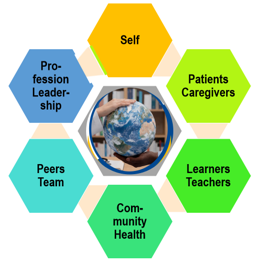
Figure 1. Professional advocacy targets. The central image was created with AI by Reyhane Golfab to illustrate the global efforts in speaking up in the healthcare professions.
While no one argues that advocacy is important for the “helping professions,” there are diverse views of “What Advocacy Looks Like.” Gerald Stapleton’s essay on the conference-related Image Collection illustrated and discussed the diversity of perspectives in a previous Academy Newsletter (Vol 9, Issue 5).
Clearly, advocacy is a complex topic which raises many difficult-to-answer questions such as:
- Where does the obligation to advocate start, where does it end?
- What is the difference between advocacy and political activism?
- How can one mitigate conflicts between advocating for oneself and advocating for others?
- How to address moral distress when advocacy fails?
- How can we teach and assess advocacy skills?
The June 2026 international hybrid conference of the Academy for Professionalism in Health Care (APHC) provided unique opportunities to take a deep dive into the complexities of this competency and its relation to professionalism.
The three-day event occurred at Cooper Medical School of Rowan University in Camden, NJ and via Zoom. It involved 199 participants from 15 countries. Practitioners in various professions and learners at various training levels represented all four APHC “pillars”: Education, Clinical Care, Public Health and Bioethics. The event included three keynote presentations and three symposia, 36 oral or flash presentations, 29 interactive sessions (e.g., workshops, problem solving), two simulation exercises plus an art walk to visit local murals that used art as an advocacy tool. The overall goal of the conference was to provide an international and inclusive forum for exchanging experiences, programs, research and perspectives.
To capture the key messages of the conference we used NotebookLM to create an infographic based on the conference program which is posted online. The program contains the titles of all sessions and presentations as well as 2-sentence summaries for each one. The result is illustrated in Fig 2.
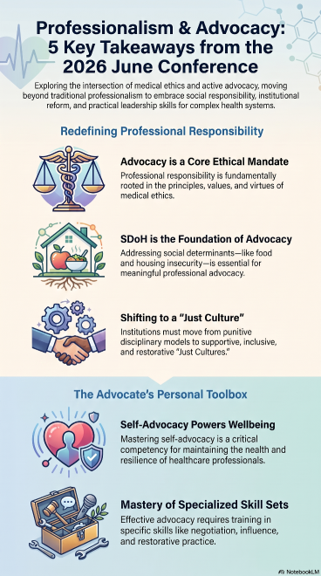
Figure 2. Summary of the 2026 Hybrid Conference Program (accessible on the APHC Website under Past Conferences) using NotebookLM
The conference clearly established the importance of Advocacy as a Professional Core Competency, requiring training as well as practice in all healthcare professions. The “Social Determinants of Health (SDoH) are critical factors to consider with every patient and, not infrequently, require clinicians to speak up in order to optimize the care they want to provide. As part of the conference, the Patient Engagement Studio under the leadership of Ann Blair and her team at the University of South Carolina created a video in which patients expressed their perspectives of what healthcare provider advocacy means to them. Clearly such clinician interventions are hoped for as part of health care delivery and greatly appreciated if they occur.
But advocacy is not just the responsibility of individual practitioners. Institutions, through their leadership staff, also have a responsibility to create an inclusive and psychologically safe environment that promotes advocacy in all its forms, and does not silence voices of concern. Professionalism lapses need to be acknowledged as possible indicators of stress and a systemic problem; they are not to be minimized as character flaws.
Mastering self-advocacy is just as important as advocating for others. It can be considered an essential wellness tool that can protect against burnout. Explicitly addressed during training, self-advocacy requires continuous attention throughout health profession careers. Models such as “Calling In” can help guide interventions but, whether it is advocating for oneself or for others, strategic problem solving and effective communication skills require practice, feedback and reflection. Group-based simulation exercises focused on accepting controversial donations and practicing critical advocacy skills with standardized participants (SPs).
To Continue the Discussion and to further deepen insights from the conference, an online Roundtable Discussion was held a month later. It was open to everyone, including those who were unable to attend the conference itself. In small groups, and inspired by short videos, participants discussed 1) Advocacy through the Humanities, 2) Teaching Advocacy: Opportunities and Challenges, and 3) Professional Advocacy in Special Contexts: Opportunities and Boundaries.
This international conference proved that advocacy is a global concern. While contexts may vary, acknowledging the need for advocacy training is universal. Similarly, whether in prosperous communities or war zones, advocacy for patients and learners as well as for oneself is an equal responsibility for all health care professionals, regardless of their field and role.
While there is never enough time to address all aspects of advocacy and professionalism, the conference was able to cover some important aspects that can have an immediate impact on education and healthcare practice. Hoping that the discussion about advocacy continues far beyond the event itself, the Planning Committee is now moving toward the next APHC conference on Professionalism: Creating a Shared Framework Across Cultures, Education, and Practice (December 2-3, 2026). The Call for Abstracts is currently underway.
Back to Table of Contents
|
| |
 Letter to the Editor Letter to the Editor
By: WR Sexson and Tracey R Bell
|
To the Editor,
As clinicians interested in professionalism and global health, we would be remiss in not sharing our perspective at the current moment. We write to encourage increased work at the nexus of those healthcare spaces.
The world is on fire. Acrimony and strife pervade the fraying of the old geo-political order. Yet people still get sick – or injured – and need help. How do we model healthcare professionalism in order to care for the array of people needing help? Does the healthcare provider just help those on their own “team” or does professionalism demand a humanitarian commitment to care for anyone who needs help?
The foundational role of the professional stems from a humanitarian commitment to others, not from a geo-political or even a cultural-religious convention. The bioethicist Art Caplan asserts that in wartime (as in the Ukraine-Russia conflict), medicine must reject the humanitarian argument and focus on “economic strangulation” of Russia1. We reject this argument and strongly feel that healthcare providers must alternatively relate to both the Russian providers and the Russian people who need the broad resources and support of the international healthcare community.
Professionalism in healthcare demands that care be modeled on equity. Participation in global health epitomizes the principle that health is a human right that should be provided to all, regardless of geopolitical factors such as race, ethnicity, gender, religious background, or nationality. Fully caring for others reinforces the premise of treating those in need according to clinical and humanitarian principles rather than political affiliation. This type of humanitarian caring also demonstrates the growth of one's individual cultural competence — a skill that can be extrapolated to national-level work on equity and reducing health disparities. Healthcare must not be weaponized, but instead it must be protective — a right afforded to all human beings.
We encourage our colleagues to engage the questions we have posed and contribute to these important global conversations.
With hope,
WR Sexson and Tracey R Bell
REFERENCE
- Caplan, AL. “Pharma should Stop Doing Business in Russia, Says Ethicist. Medscape, March 11, 2022.
Drs. Sexson and Bell have worked in many countries in the Eastern Block of the old Soviet Union. For the past 25 years, they have worked actively with health providers in Russia helping to educate providers and organize systems of care. They lead the “Global Collaboration for Maternal and Infant Health,” previously the Global Collaborating Center in Reproductive Health at Emory University in Atlanta, Georgia. (See https://GCMIH.org) At the end of the current war, they contend that their relationships and efforts between the United States and Russia will be positioned to best help “win the peace.”)
Back to Table of Contents
|
|
A Note From the Immediate Past President of APHC
By: Michelle Schmude, EdD, MBA
|
|
I leave the APHC Conference at Cooper Medical School of Rowan University with a deep sense of gratitude for the shared vision, people, and purpose that shaped this meaningful gathering. Centered on professionalism and advocacy, the conference created space to reflect not just on our work, but on the values that guide it.
Across three days of programming—including keynote presentations, concurrent sessions, symposia, and informal exchanges—participants engaged in rich dialogue and learning. Keynote speakers grounded us in purpose, challenging us to expand our understanding of professionalism, public health, and advocacy, and to reconsider our responsibilities as educators, clinicians, and leaders.
The sessions offered both depth and practical insight, addressing topics such as professional identity formation, interprofessional collaboration, and the ethical dimensions of emerging technologies like AI. The diversity of perspectives ensured relevance for all attendees while encouraging new ways of thinking.
Equally valuable were the connections formed outside of formal sessions. Networking breaks and shared meals created opportunities for meaningful conversations that strengthened our collective commitment to advancing professionalism and advocacy.
I extend sincere thanks to Cooper Medical School of Rowan University for their partnership and support, and to the APHC planning committee for their exceptional leadership in creating a thoughtful and impactful program.
Finally, I am grateful to the speakers, facilitators, and participants whose engagement made this conference so impactful. As I conclude my term as APHC president (2024–2026), I remain energized and optimistic about the future of our field.
Michelle Schmude, EdD, MBA, serves as Vice Provost for Enrollment Management, Professor of Medical Education, and founding faculty member at Geisinger College of Health Sciences. She brings leadership experience in academic administration, enrollment management, marketing, and communications from roles at Point Park University, King’s College, and Geisinger. She serves on the faculty of the Harvard Macy Institute’s Program for Educators in Health Professions and is the Past President of the Academy for Professionalism in Health Care.
Back to Table of Contents
|
| |
|
|
|
|
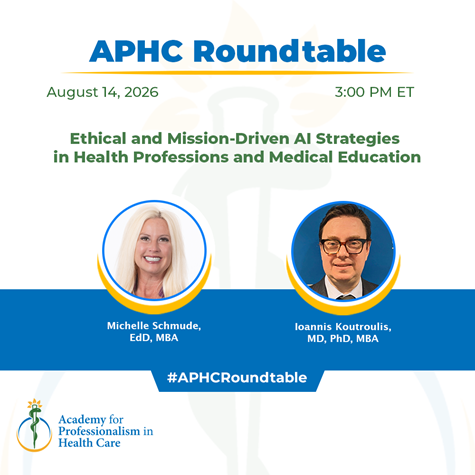
Artificial intelligence is transforming health professions and medical education, creating new opportunities alongside important ethical, governance, and implementation challenges. In this interactive professional development session, participants will explore mission-driven approaches to AI adoption through the lens of the Josiah Macy Jr. Foundation recommendations and emerging national competency frameworks. Using a real-world institutional case study, attendees will assess organizational readiness, identify responsible strategies for integrating AI into student-impacting processes, and discuss practical applications across education. Through guided reflection, active learning, and peer discussion, participants will leave with actionable tools, ethical considerations, and implementation strategies to support responsible AI innovation within their organizations.*
*Created for the session slide deck using AI.
About the Presenters:
Michelle Schmude, EdD, MBA, Professor of Medical Education and Vice Provost for Enrollment Management.
Ioannis Koutroulis MD, PhD, MBA, Associate Dean of Admissions and Professor of Pediatrics and Emergency Medicine.
Register at: https://tinyurl.com/2026Roundtables
Roundtables are for APHC Members only.
Check out our membership benefits here.
Join APHC to access previous Roundtable recordings.
Back to Table of Contents
|
Healthcare Professionalism: Education, Research & Resources Podcast
|
Professional Formation and APHC collaborate on a podcast, Healthcare Professionalism: Education, Research & Resources.
Over 125 podcast episodes have been released with over 17,000 downloads.
Released every other Saturday morning, recent episodes include Rachel Pittmann discussing Telehealth Etiquette and Amal Khidir talking about Designing the Faculty Development Professionalism Program with Multi-cultural Perspectives.
You can access the podcast episodes on your favorite platform or at: https://bit.ly/PF-APHC-Podcast
Back to Table of Contents
|
APHC Member Announcements
|
If you are an APHC member, we will publicize your events, job searches, research, grants, articles, podcasts, books, etc., in the newsletter.
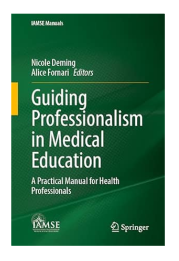 Michelle Schmude (APHC Past President), Tanja Adonizio (APHC President), Halle Ellison (APHC Treasurer), Ryan Weber (APHC member), John Arnott, and Jennifer Koestler wrote “Teaching Professionalism in Undergraduate Medical Education” in Guiding Professionalism: Strategies for Medical Education Across the Continuum. The book was edited by Alice Fornari (APHC Board Member At-Large) and released in July 2026. Available for download on Amazon and Springer. Michelle Schmude (APHC Past President), Tanja Adonizio (APHC President), Halle Ellison (APHC Treasurer), Ryan Weber (APHC member), John Arnott, and Jennifer Koestler wrote “Teaching Professionalism in Undergraduate Medical Education” in Guiding Professionalism: Strategies for Medical Education Across the Continuum. The book was edited by Alice Fornari (APHC Board Member At-Large) and released in July 2026. Available for download on Amazon and Springer.
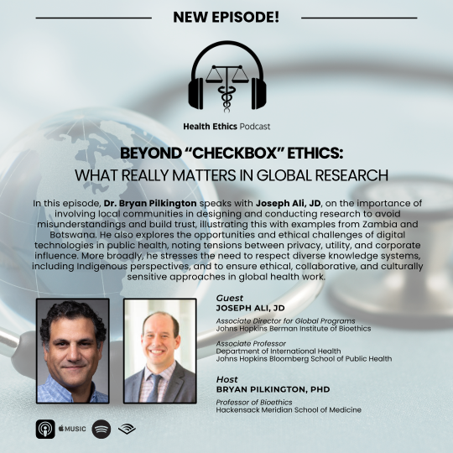
In the latest episode of the Health Ethics podcast, Prof. Joseph Ali discussed global health ethics and research. Check it out here: https://library.hmsom.edu/health-ethics/listen-now or wherever you get your podcasts. Show notes and related content are available here: https://library.hmsom.edu/health-ethics/show-notes.
Back to Table of Contents
|
As a member, you have access to special benefits that include:
- Belonging to a community of like-minded professionals
- Participating in the monthly Professionalism Education
Roundtables with authors, faculty, and researchers, plus accessing past recordings
- Accessing 15 Professional Formation modules for individuals for free
- Enrolling in the APHC Faculty Development Certificate program known as LEEP (Leadership Excellence in Educating for Professionalism), which was launched in 2020 and offers longitudinal mentoring for a select group of
individuals seeking to deepen their knowledge and skills in
professionalism education, assessment, and research
- Posting your research, articles, podcasts, webinars, conferences, and books in the newsletter distributed to about 15,000 people
- Receiving a 20% discount on educational videos created by the Medical Professionalism Project, which also allows you to obtain MOC and CME
- Registering for APHC conferences with discounts
- Participating in APHC committees, which include the conference program, membership, and education committees
Our annual membership fees are very inexpensive and are valid for one year from the payment date. Select from seven types of membership, including the institutional membership for four people. See the descriptions.
Back to Table of Contents
|
The Academy Newsletter Editors
|
Editor-in-Chief: Bryan Pilkington | Managing Editor: Yvonne Kriss
Please contact Yvonne if you'd like to contribute an article to this newsletter.
If you know someone who would benefit from reading The Academy, please pass this along. They can subscribe to the newsletter by clicking here.
|
Academy for Professionalism in Health Care
PO Box 20031 | Scranton, PA 18502
|
Follow us on social media.
|
|