Volume 9, Issue 6 - June 2026
|
Advocating for Advocacy in Professional Spaces: The Conference Issue
By: Bryan Pilkington, PhD
|

Our June issue is coming to you later in the month than usual, which allows us to wax philosophically about themes that arose in the excellent international hybrid conference which took place early in the month. It also gives us an opportunity to plug the conference postmortem, which will take place on Zoom July 10 at 12:00 pm Eastern.
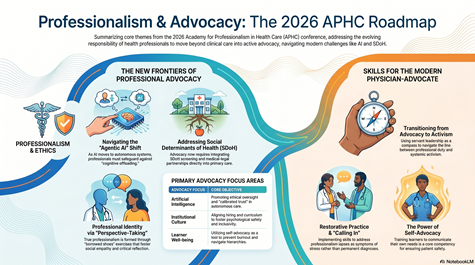
The annual conference issue is great fun to edit and put together. It offers an opportunity (see the final of our three articles) to reflect on some of the great presentations that were given. The theme of this year’s conference was advocacy – Professionalism and Advocacy: Achievements, Barriers, Complexities – and presenters engaged the concept in all of its forms. Considerations of advocacy also run through the first two articles in this issue. In “The White Coat Means Something. We Should Be Honest About What,” Rebecca Lukowski Stone and Sabrina Kovler raise pressing questions about who should wear whitecoats and when. This important symbol of medicine and, more broadly of the scientific endeavor, takes on a special meaning during this time of year when whitecoat ceremonies take place across medical schools. This timely reflection opens up space for a conversation about the variety of professionals and others who contribute to the education and formation of future health professionals. Advocating for inclusiveness in medicine, for the importance of place for those who contribute without holding a medical degree, for justice in the workplace are all laudatory endeavors; but what does the whitecoat mean and what is it really for? Read below and find out.
Our second article, “Ethics, Bioethics, and Professionalism: The Crisis that is, Today,” by Tom Koch, outlines a challenge facing health professionals and – though Koch does not use the term – an opportunity for advocacy. The values of medicine, rooted in the ethics of care, do not align with the commercial focus that exists in many places in healthcare. Koch takes the field of bioethics to task in a provocative and critical piece. I suspect both this article and the opening article will be much discussed in next month’s letters to the editor.
The final article is the editor’s conference recap, with apologies for all of the many sessions that were not mentioned and a request – if you attended a good one – to drop us a line and share what worked in the session and how it has impacted your thinking on advocacy and professionalism.
In addition to the usual goings on about the professionalism town – announcements, members achievements, et cetera, I remind you to please consider attending the conference postmortem and to look out for our special double issue in August. Readers will also notice our new section, Letters to the Editor, is going strong. This issue has a thoughtful note from Caryn Katz-Loffman on professional identity formation. If something in this or a previous issue strikes you or if you can lend some additional expertise to our conversations, please send us a letter. You can email us (exec@aphc-mail.org) and please keep the notes under 250 words.
I close this introduction to the issue with my gratitude to Michelle Schmude for her excellent leadership of APHC and stewardship of the organization. We’re all in her debt and now look forward to Tanja Adonizio’s guidance over the next few years.
Bryan Pilkington, PhD, is Professor of Bioethics, in the Department of Medical Sciences, at Hackensack Meridian School of Medicine, and the Editor-in-Chief of The Academy: A Forum for Conversations about Health Care Professionalism.
|
APHC Professional Development Committee Survey
AP |
|
|
The Academy for Professionalism in Health Care (APHC) Professional Development Committee (PDC) invites members and nonmembers of the APHC community to share their perspectives on mentoring and professional development needs.
Our goal is to better understand the interests and priorities of our community so we can design meaningful offerings for 2026–2027 and foster a vibrant community of practice that supports and enriches our professional roles.
This brief survey will help guide our next steps. Please share your input using this survey link or the QR code below.

Back to Table of Contents
|
|
|
The White Coat Means Something. We Should Be Honest About What.
By: Rebecca Lukowski Stone, MA and Sabrina Kovler, MHA, MPhil
|
Every year, medical schools across the country gather to celebrate one of the most symbolic moments in a physician’s formation and identity: the White Coat Ceremony. Families cry. Cameras flash. Students, standing at the threshold of an arduous and transformative journey, put on their white coat for the first time and recite a physician’s pledge before entering the profession they have spent years chasing and choosing.
The ceremony is intentionally aspirational. It is not a graduation. It is not a credentialing event. It is a public declaration of intent — a symbolic welcome into the moral and professional responsibilities of becoming a doctor.
That symbolism matters precisely because medicine treats symbols seriously. The white coat itself has long represented trust, accountability, service, and the social contract between physicians and patients. The physician’s pledge, recited in community with practicing MDs and DOs, reinforces that this moment marks the beginning of a student’s journey towards those same credentials, and holds students accountable from the very beginning to become humanistic providers (Huber, 2003).
Which is why medical schools should pause before extending that symbolism indiscriminately.
Increasingly, some institutions invite non-physician faculty and staff to wear white coats during the ceremony alongside physicians and students. The intention is to honor the many professionals who contribute to medical education and to demonstrate a commitment to interprofessional collaboration. Modern medicine is a team sport. Physicians do not work in isolation, nor should they. Nurses, social workers, educators, researchers, administrators, pharmacists, and countless others shape medical education and patient care in essential ways.
Acknowledging the value of collaboration is different from collapsing distinctions altogether.
The White Coat Ceremony is not fundamentally about teamwork. It is specifically about the formation of the identity of a physician. Students are not merely joining a healthcare ecosystem; they are entering a profession with unique ethical obligations, licensure requirements, and societal expectations. The physician’s pledge is not a generic statement of compassion or service; it’s a professional oath tied to the responsibilities of becoming a doctor. This is not an argument for hierarchy or exclusion. In fact, there are unintended consequences in asking non-MDs to wear the same symbolic garment in a ceremony centered on physician identity: it can inadvertently diminish the distinct expertise and professional identity of everyone involved.
Interprofessional education works best when professions are respected for what they uniquely contribute — not when those differences are blurred into symbolic sameness. A PhD scientist teaching and mentoring medical students does not require a white coat at a physician’s oath ceremony to demonstrate importance. A social worker does not need to symbolically become a physician in order to help students understand what it means to lead with humanism. An administrator who shapes the student experience contributes meaningfully regardless of attire.
There is a difference between inclusion and imitation.
Ironically, institutions that pride themselves on mission-driven interprofessional collaboration may undermine that very mission when they suggest that participation in physician symbolism is the highest form of belonging. If every contributor must visually adopt the physician’s uniform during a physician rite of passage, what message does that send about the worth of non-physician roles on their own terms?
Medical schools should instead model a healthier understanding of collaboration: one in which professions stand alongside one another with mutual respect, not symbolic interchangeability.
Ceremonies communicate institutional values. They tell students what matters. A White Coat Ceremony tied explicitly to the physician’s pledge communicates entry into the ethical and professional identity of medicine. When everyone wears the same symbol regardless of role, the institution risks muddying the very meaning it claims to celebrate.
Medical education already struggles with questions of professional identity formation (Sternszus et al., 2024). Students enter training at a time when public trust in institutions is fragile, physician burnout is high, and the role of doctors within healthcare systems is rapidly evolving. The answer to those challenges is not to weaken professional symbolism, but to use it thoughtfully and honestly.
The solution is not exclusion. Schools can and should celebrate the full community that supports medical education. Faculty and staff from every discipline deserve recognition, gratitude, and visibility during milestone events. There are countless meaningful ways to honor collaboration without repurposing symbols rooted in physician formation.
Because the White Coat Ceremony is, at its core, about becoming a physician.
And if we believe that journey still carries distinct meaning, then the symbols surrounding it should mean something too.
WORKS CITED
Huber, S. J. (2003). The white coat ceremony: A contemporary medical ritual. Journal of Medical Ethics, 29(6), 364–366. https://doi.org/10.1136/jme.29.6.364
Sternszus, R., et al. (2024). Being, becoming, and belonging: Reconceptualizing professional identity formation in medicine. Frontiers in Medicine, 11, 1438082.
https://doi.org/10.3389/fmed.2024.1438082
Rebecca Lukowski Stone is a medical education operations leader at Hackensack Meridian School of Medicine, where she helps lead the operational and curricular functions of the Office of Medical Education.
Sabrina Kovler is an academic medicine administrator at the Hackensack Meridian School of Medicine. Her most recent research tied to her doctoral studies focus on social determinants of health curricula in medical education.
Back to Table of Contents
|
Ethics, Bioethics, and Professionalism: The Crisis that is, Today.
By: Tom Koch, PhD
|
“In its ideal form, the practice of medicine is a fundamentally moral activity in which physicians act in their patients’ best interests. However, physicians frequently encounter situations in which upholding professional ethical values is challenged when they feel their environment constrains the ethically right course of action” (Tutty, West, Dyrbye et al. 2025).
Healthcare professionalism is not facing ‘a potential identity crisis’ (Hader 2026). Instead, practitioners today are confronting an existential crisis in which a relational ethic of care in service of both the individual and society-at-large is stymied by disenfranchised systems governing care served by a commercially grounded Bioethics. Its principal focus is neither the patient in need not the autonomous customer cum client but financially grounded, bureaucratic constraints. Ever-increasing rates of dissatisfaction and burnout have been the inevitable result.
For two millennia and more, medical morality and a resulting ethics of practice was grounded in a social compact ordering relations between practitioners, patients, and the societies in which they together lived (Mackenny 1952, 2-3). Its ethical lynch pin was the famous Hippocratic Oath declaring the practitioners’ allegiance to an ethical system grounded in a morality proclaiming life’s preservation and an ethics of care as primary social goods. It served to affirm membership in a class of professionals dedicated to the common good as “a powerful reminder and declaration that we are all a part of something infinitely larger, older, and more important than a particular specialty or institution” (Markel 2004).
In the late 1970s this “taken for granted ethos” (Jotterand 1995, 124) was rejected by a cadre of moral philosophers, bioethicists, who sought to replace practitioners as “keepers of the medical conscience” (Nutton 1997,43). Declaring the traditional ethic outdated (Beauchamp and Childress 1979, 2), bioethicists dismissed the Hippocratic vision summarized in its Oath as if not dead (Veatch 1988) then at best a symbolic, historical artifact (Miles 2004, 50).
Its cooperative and relational ethic of care and service (Pellegrino and Thomasma 1982) was replaced with one that was transactional and commercial in its focus on the autonomous patient-as-consumer (Mol 2002, 169-171). Autonomy permitted issues of morality and care to be reduced to a system of commercialism in which the practitioner’s expertise and knowledge were devalued. In this revision, “the market was treated as a moral, not just an efficiency value …little interested in an idea of the common good” (Callahan 2012, 132-3). The result has been “disenfranchised systems of commercial practice that limited their [practitioners’] ability to fulfill the ideals the earlier ethic invoked” (Lamiani, Borghi, and Argentero 2017).
Not surprisingly, perhaps, recitation of The Oath, at least in its classical form, has declined as a result (Crawshaw 1994). Some have done away with its declarations altogether. Where the Hippocratic Oath has survived it has been as a quixotic, last ditch resistance to “the deformation of medical professionalism by bioethics, biopolitics, and governmental regulation” (Jotterand 2005,107). Understanding that deformation explains the parameters of the existential crisis that plagues practitioners today.
Prior to the rise of Bioethics in the 1980s, “Physicians were considered professionals accountable to standards and values that were different from those prevailing in typical markets” (Bluementhal and Galfin 2025). With Bioethics’ market focus, practitioners were to be seen not as partners in care, authorities with experience, but technicians lacking any more ethical insight or moral standing than the average shoe salesperson (Veatch 2012, 25).
Despite its emphasis on autonomy, Bioethics sought to shift the focus of practitioner duties from the needs of a patient to the demands of employers and the policies of officialdom. “The Hippocratic ideal ignored the possibility of a social ethics in which physicians may have the right or duty to sacrifice their patients for the good of others in society” (Veatch, 2012, 14). With Bioethics, practitioners were enjoined to “first and foremost serve the needs of the state” (Callahan, 1990, 253). Patient choice was to be a secondary good in healthcare’s official priorities and directions.
In healthcare, “Professionalism” promoted a system of identity formation (Cruess and Cruess, 1997) in which medicine was joined as a junior, largely unsung partner in an unwritten, never negotiated contract with business and government (Cruess and Cruess 2000). Bioethics was folded into this system, an implicit partner in its reordering of ethical priorities (Koch 2013).
No wonder that, “over the past thirty years there has been a steady shift form seeing doctors as independent professionals to seeing them as mere employees in large organizations often led by people who have little appreciation for clinical care” (Christakis 2020). 152-3). Little surprise that the tradition of practitioners serving as social “guardians” (Jane Jacobs 1992) who might identify and criticize the excesses of officialdom, bureaucratic and commercial has diminished.
And here is the crisis in sharp relief. Believing in the value of individuals as a moral ideal the older ethic set the physician’s duty to the patient above all other imperatives. Physicians were set in a position of trust, responsible to and for the patient based on experience and special knowledge not available to the layperson or the average, philosophically-trained bioethicist. And yet, with Professionalism’s embrace of Bioethics’ unspoken compact, medicine has become for many more frustrating than fulfilling in a system that too often rejects the complex realities of care and the caring ideal that for two millennia and more defined the practice of medicine.
REFERENCES
- Abbasi K. 2026. The power of the markets: the scandal that keeps on taking. BMJ 393 (S683). doi: https://doi.org/10.1136/bmj.s683.
- Blumenthal D, Galfin R. 2025. The Vocabulary of Our Discontent. JAMA 19 (1). Epub. Aug 18, Doi: 10.1001/jama2025.12584.
- Callahan D. 1990. What Kind of Life? The Limits of Medical Progress. Washington, DC: Georgetown University Press.
- Callahan D. 2012. In Search of the Good: A Life in Bioethics. Cambridge, MA: MIT Press.
- Christakis NA. 2020. Apollo’s Arrow: The Profound and Enduring Effect of Corona virus on the way we live. NY: Little, Brown and Spark.
- Crawshaw R. 1996. The Hippocratic oath Is alive and well in North America. BMJ 1994; 309 (952). doi: https://doi.org/10.1136/bmj.309.6959.952.
- Cruess SR and RL Cruess. 1997. Professionalism Must be Taught. British Medical Journal 315:1674-1677.
- Cruess SR, Cruess RI. 2000. Professionalism: A Contract between Medicine and Society. CMAJ 162:668e9.
- Harder T. 2026. Healthcare Professionalism’s Approaching Identity Crisis: Is It Time to Start Saying the Quiet Parts Out Loud? The Academy 9 (5). https://mailer.aphc-mail.org/mailer/subscriber/newsletter.php?r=757b85687ea6697aa37a8a9076a663
- Jacobs J. 1992. Systems of Survival: A Dialogue on the Moral Foundations of Commerce and Politics. NY: Vintage Books.
- Jotterand F. 2005. The Hippocratic Oath and Contemporary Medicine: Dialectic Between Past Ideals and Present Reality? Journal of Medicine and Philosophy, 30:107–128, 2005.
- Koch T. 2012. Thieves of Virtue: When Bioethics Stole Medicine. Cambridge, MA: MIT Press.
- Koch T. 2013. The Hippocratic Thorn in Bioethics’ Hide: Cults, Sects, and Strangeness Journal of Medicine and Philosophy doi:10.1093/jmp/jht056
- Lamiani G, Borghi L, Argentero P. When healthcare professionals cannot do the right thing: a systematic review of moral distress and its correlates. J. Health Psychology 2017; 22(1):51-67. https://jamanetwork.com/journals/jamanetworkopen/fullarticle/2846921
- Markel H. 2004. I Swear by Apollo” — On Taking the Hippocratic Oath“. NEJM 350 (20): 2026-202. Doi: 10.1056/NEJMp048092.
- Miles, S.H. (2004). The Hippocratic Oath and the ethics of medicine. Oxford: Oxford University Press.
- Mol A. 2002. The Body Multiple: Ontology in Medical Practice. Durham, NC: Duke University Press.
- Nutton V. 1993. Beyond the Hippocratic Oath. In, Wear A. Geyer-Kordesch J, Frenc R., Eds. Doctors and Ethics: The Earlier Historical Setting of Professional Ethics. Clio Medica Online 24. ISBN: 978-90-04-41834-9
- Nutton, V. (1997, 43). Hippocratic morality and modern medicine. In: H. Flashar et al. (Eds.), Médecine et morale dans l’Antiquité (pp. 30–63). Geneva: Fondation Hardt.
- Tutty M, West C.P, Dyrbye L.N. et al. 2026. Moral Distress and Occupational Burnout in US Physicians. JAMA Online 9 (3): e263161. doi:10.1001/ jamanetworkopen.2026.3161.
- Veatch, R.M. (1988). The Hippocratic ethic is dead. The New Physician, 48, 41–42. says the oath is irrelevant and ..dead.
- Veatch R.M. 2012. Hippocratic, Religious, and Secular Medical Ethics. Georgetown University Press.
Tom Koch is a medical ethicist, geographer, and historian at the University of British Columbia. The author of more than 200 papers, his most recent book is Seeking Medicine’s Moral Centre: Ethics, Bioethics, and Assistance in Dying.
Back to Table of Contents
|
Philosophical Foundations of Advocacy: An Abridged Conference Recap
By: Bryan Pilkington, Editor-in-Chief
|
What a conference! Kudos to Elizabeth Kachur, Amal Khadir, and Mary Kollmer Horton for the amazing work to put together an international hybrid conference. Many conferences boast such a description but living up to it is something else entirely. Managing in person and remote presenters, audience members and even a remote option for an art walk… many, many thanks to them, Michelle Schmude, Tanja Adinazio, Dennis Novak, and - of course - Yvonne Kriss, for making it all happen.
The conference brought together clinicians, scholars, and students from across the globe to discuss the urgency and complexities of advocacy related to health professionalism. Should advocacy be a core competency in healthcare training? What does it mean to advocate for patients but also for colleagues? Are more seasoned clinicians or professors expected to advocate for recently minted healthcare professionals or students? There were a host of excellent presentations, panels, workshops, and some great networking opportunities. That said, here are some of the highlights from my coverage of the conference. I will, as I do each year, leave out some excellent presentations – just another reason to become a member of APHC (or renew that membership)... access to recorded content is a huge benefit with so many great sessions occurring at the same time.
The keynote presentations are always a conference highlight for me. My own teaching sessions employ active learning techniques – as is the norm in most health professions education – so, it is always a treat to enjoy a really good lecture. There’s an art to such a presentation and the opening keynote by Dr. Thomas Nasca was a masterclass in the medium. Dr. Nasca wove together various philosophical strands – foundational points and their subsequent arguments – together to form a cohesive narrative assessment of advocacy and professionalism. Despite his own humble self assessment, the lecture was both accessible and argued at a very high level. Nasca’s employment of normative ethics (focusing on two of the “big three” ethical theories - virtue ethics and deontology) was spot on and a helpful evaluative tool for those of us thinking about professionalism and advocacy. Leaving out consequentialism, the third commonly discussed theory in normative ethics, was instructive. Nasca’s lecture repays revisiting and his elucidation of the concept of a social covenant is something that could serve as a groundwork for much work in professionalism and healthcare in the future. Covenant takes us beyond notions of contract – even rich philosophical ones, such as those of John Rawls – and might serve to undergird (and potentially allow for the reestablishment of) trust. Time ran out for questions, but of those asked of Nasca, many participants were interested in dual loyalties – a topic for a future conference, I am sure.
Another highlight, in my estimation, was the second keynote by Shari Erickson. In “Back to the Future: How Engagement in Advocacy Can Help Save our Health Care and Public Health Systems,” Erickson discussed some very practical and interesting features of professional advocacy work. She highlighted helpful lessons, especially for those interested in doing direct work in this space. The importance of pacing oneself was clear, if not outrightly stated. In the current climate, Erickson noted that there may be three or four top priorities or goals that the lobbyists she works with aim for in a year. One need not do it all, all the time. Also of note was the responsiveness of good advocacy work to the current context. Thwarting a few missteps in national health policy might be enough, given the socio-political environment, to call it a win. With all that current and future health professionals face (and will face) and the expanding circles of influence and ever increasing sets of duties that are becoming part and parcel of what it is to be a health professional, I found Erickson’s approach to advocacy very helpful. A fun fact – and do consider penning a letter to the editor if this is common in the spaces in which you work – this was the first address I’ve heard where an AI system itself was cited. Erickson relied on Claude for a definition – not that an AI system assisted with finding the definition or explaining some concept given x, y, or z source, but the system itself was quoted (as if it were an author). Erickson highlighted the benefit of such systems and helpfully reminded us all to double check any outputs. Her transparency was most welcome and – for those of us interested in academic questions around authorship and attribution – there is a related set of questions (beyond the topic of advocacy) that this engaging lecture gives rise to.
A final (well…penultimate) highlight was a talk by Jake Sasso, an MD candidate at Cooper, on problem based learning. Sasso and colleagues offered a good discussion of the subject matter, but what was extremely well done was their careful attention to the need for advocacy given different personality types. It is not uncommon for instructors to rely on a wide array of evaluative mechanisms in class, given that every student is distinct. You might accept an email as similar to class participation, for example, if students are more introverted. Framing this as advocacy and thinking about small group construction as a way to advocate for students of various personality types and learning styles was a take home point and one that received great discussion in this session.
The last highlight, for me, was a nice moment that came out of a seeming hiccup. I attended a session on a topic I am very, very interested in. As we waited for the presenters, the opportunity to chat with other attendees was great. As it turned out, the presenters never showed… but the experience highlighted for me how caring and cordial the members of communities of practice that have built up around APHC are. This wasn’t a lost moment, as it might have been at many other conferences. It was a great chance to catch up and chat before easily hopping into another session.
Check out the recordings of anything you missed, write to us if you have follow up thoughts, and I hope to see you at the next conference.
Bryan Pilkington, PhD, is Professor of Bioethics, in the Department of Medical Sciences, at Hackensack Meridian School of Medicine, and the Editor-in-Chief of The Academy: A Forum for Conversations about Health Care Professionalism.
Back to Table of Contents
|
| |
 Letter to the Editor Letter to the Editor
By: Caryn Katz-Loffman
|
To the Editor,
Bynum and Dolezal’s article on shame and professionalism puts language to something many of us see in medical education but do not always name directly. The standards we set for learners matter, but so does what those standards come to mean when someone falls short, especially in moments that may seem small on the surface but carry consequences for others.
I was reminded of this recently while working with a learner who missed a required step in a scheduling process. It was not careless or intentional. They assumed the next step had been handled and they moved on. What followed was familiar to anyone who works in education or clinical systems. Faculty time was lost, schedules had to be rearranged, and others stepped in to repair what had been missed.
What stayed with me was not the lapse itself, but the learner’s reaction once they began to understand the ripple effect. Initially, they saw it as an administrative mistake. Over time, through conversation and reflection, they began to see something deeper. Reliability is not simply about getting tasks done. It shapes how other people experience you. It affects whether colleagues feel supported. It affects whether people believe they can count on you. It affects whether patients and their families can trust you as their health partner.
Your article raises an important question about how we respond when standards are not met. In my experience, those moments can either trigger shame and withdrawal, or they can open the door to growth, depending on how we frame them. When learners see professionalism not as a judgment, but as an ongoing process of becoming, accountability feels less like punishment and more like growth.
For many learners, that shift may be where professionalism becomes something more than compliance. It becomes relational. And perhaps that is where some of its deepest lessons begin.
Caryn Katz-Loffman is Director of Professional Identity Formation and Assistant Course Director for Human Dimension at Hackensack Meridian School of Medicine, where her work focuses on humanistic medicine through the lens of professional identity formation, reflective practice, community-engaged medical education, and professionalism.
Back to Table of Contents
|
|
APHC Roundtable
|
Please join us on Friday, July 10, 2026, at 12 p.m. ET for APHC's Roundtable "Professionalism and Advocacy: Continue the Conversation."
After a thought-provoking hybrid Academy for Professionalism in Healthcare Conference, we are continuing the conversation.
Small Group Discussions will focus on:
- Advocacy through the Humanities
- Teaching Advocacy: Opportunities and Challenges
- Professional Advocacy in Social Contexts: Opportunities and Boundaries
Register at: https://tinyurl.com/APHCJulyRoundtable
This Roundtable is open to everyone.
Join APHC to access previous Roundtable recordings.
Back to Table of Contents
|
|
|
Early Registration for ABMS Conference 2026 Is Now Open
|

|
Early registration for ABMS Conference 2026, which will be held Sept. 16–18 at the Loews O’Hare Hotel in Rosemont, Ill., is now open.
As the premier health care event on board certification, ABMS Conference 2026 brings together thought leaders from across the certification community who are focused on improving certification programs and the delivery of high-quality patient care. Participants with roles in assessment, lifelong learning, improvement, research, and professionalism will explore practical strategies and forward-thinking ideas that advance certification programs alongside a rapidly changing health care system.
ABMS Conference 2026 includes:
- 2 ½ days of sessions
- 2 plenary sessions
- 40 concurrent sessions
- 40 posters
- 1 Sponsor Spotlight
- 4 Exhibitor Showcases
- Exhibit Hall
- Networking opportunities
Speakers for the opening plenary will explore The Evolving Medical Workforce Landscape – From Unionization to Private Equity Practice Ownership, while speakers for the Lois Margaret Nora Endowed Lecture Plenary will discuss The Patient Voice: The Importance of Involving the Patient Perspective in the ABMS Community.
Early registration pricing will be available until 11:00 pm (CT) on July 31. View the full schedule and visit the ABMS Conference 2026 website to learn more about the event and register.
Back to Table of Contents
|
Healthcare Professionalism: Education, Research & Resources Podcast
|
Professional Formation and APHC collaborate on a podcast, Healthcare Professionalism: Education, Research & Resources.
Over 125 podcast episodes have been released with over 17,000 downloads.
Released every other Saturday morning, recent episodes include Rachel Pittmann discussing Telehealth Etiquette and Amal Khidir talking about Designing the Faculty Development Professionalism Program with Multi-cultural Perspectives.
You can access the podcast episodes on your favorite platform or at: https://bit.ly/PF-APHC-Podcast
Back to Table of Contents
|
APHC Member Announcements
|
If you are an APHC member, we will publicize your events, job searches, research, grants, articles, podcasts, books, etc., in the newsletter.
Back to Table of Contents
|
As a member, you have access to special benefits that include:
- Belonging to a community of like-minded professionals
- Participating in the monthly Professionalism Education
Roundtables with authors, faculty, and researchers, plus accessing past recordings
- Accessing 15 Professional Formation modules for individuals for free
- Enrolling in the APHC Faculty Development Certificate program known as LEEP (Leadership Excellence in Educating for Professionalism), which was launched in 2020 and offers longitudinal mentoring for a select group of
individuals seeking to deepen their knowledge and skills in
professionalism education, assessment, and research
- Posting your research, articles, podcasts, webinars, conferences, and books in the newsletter distributed to about 15,000 people
- Receiving a 20% discount on educational videos created by the Medical Professionalism Project, which also allows you to obtain MOC and CME
- Registering for APHC conferences with discounts
- Participating in APHC committees, which include the conference program, membership, and education committees
Our annual membership fees are very inexpensive and are valid for one year from the payment date. Select from seven types of membership, including the institutional membership for four people. See the descriptions.
Back to Table of Contents
|
The Academy Newsletter Editors
|
Editor-in-Chief: Bryan Pilkington | Managing Editor: Yvonne Kriss
Please contact Yvonne if you'd like to contribute an article to this newsletter.
If you know someone who would benefit from reading Professional Formation Update, please pass this along. They can subscribe to the newsletter by clicking here.
|
Academy for Professionalism in Health Care
PO Box 20031 | Scranton, PA 18502
|
Follow us on social media.
|
|